If you’re familiar with ballet, you might know a ballet called La fille mal gardée. This ballet (the name translating to The Poorly Guarded Girl) is one of the oldest surviving ones, although not with it’s original choreography, or music. What we know as La fille mal gardée can be traced back to other choreographers: Frederick Ashton’s 1960 production, Alexander Gorsky’s 1903 production, Lev Ivanov and Marius Petipa’s 1885 production, and Paul Taglioni’s 1864 production. But who was the original choreographer, and what were his contributions to dance?
In Spotlight On, I aim to focus on individuals, or theatrical shows, that have contributed a lot to the art as a form. For individuals, I aim to provide a glimpse into their life and works, and make people more familiar with them. For shows, I aim to provide a history of them, while also focusing on the people who have brought them to us today.
Birth & Early Life
Jean Bercher, also known as Dauberval, was born in Montpellier, France, on the 19th August 1742. His father was Étienne-Dominique Bercher who, slightly confusingly, also went by the name of Dauberval. Étienne (9th January 1725-5th August 1800) was an actor. He debuted with the Comédie-Française in 1760, and became a sociétaire in 1762. Among the roles he played were Horatio (renamed Norceste) in Jean-François Ducis’ 1769 translation of Hamlet, and Dorante in Molière’s Le Bourgeois gentilhomme. He retired in 1780.
As a student, Jean studied with Jean-Georges Noverre. Noverre was a revolutionary talent in the dance world. In 1760 his Lettres sur la danse, et sur les ballets was published. In this book, Noverre criticises the conformist Paris Opera (as the ballet and opera were under a single name), and proposes a more expressive form of ballet, inspired by his observations of actor David Garrick. This form of ballet would be called ‘ballet en action‘, but would become known as ‘ballet d’action‘, being retroactively coined by critic and writer Théophile Gautier in 1855.
Noverre would become maître de ballet at the Paris Opera Ballet in 1776, but would resign in 1781. During his time he staged ballets he had choreographed, including Jason et Médée, one of his greatest choreographic successes, and Les petits riens, which premiered at the Opera Ballet in 1778 and had music by Mozart. His premier danseurs at the time included his student, Jean Dauberval.
Career
Dauberval the younger made his debut at the Paris Opera on the 12th June 1761. As not much is known about the ballet repertoire of the day, the roles he danced are unknown. However we can get an idea of what type of roles he danced. In 1763 he was appointed premier danseur de demi-caractère. Demi-caratère was the bridge between the the noble style of dance, and the comique style of dance, and favoured mime and expression. Jean became known as a first rate mime, and was promoted to premier danseur noble in 1770.
On the 8th June 1781, 20 years after Jean’s debut, there was a fire at the Opera House in the Palais-Royal, which had only opened in 1770. Jean was the first to spot the flames, and as the performance was nearly over, he managed to get the curtain lowered and the audience out without them even knowing of the fire. While lives were lost, Jean averted a greater tragedy. The same year, Noverre resigned, leaving Jean and fellow premier danseur Maximilien Gardel as joint maîtres de ballet. But this arrangement wouldn’t last long.
Between 1777 and 1782 Mademoiselle Théodore, who’s real name was Marie-Madeleine Crespé, was a ballerina at the Paris Opera Ballet. Marie-Madeleine was born in 1759, and had made her debut on the 26th December 1777. In 1782 she danced in London, in the ballet troupe of Noverre. Dauberval had fallen in love with Marie-Madeleine, and in 1783 they resigned from the Opera. Both of them seem to have had problems with the management, particularly Maximilien Gardel, and after their resignation they would never return. On the 30th October 1783, they were married.

Bordeaux
Jean and Marie-Madeleine would choreograph and dance respectively at the King’s Theatre, London, England, from 1783-1784. After this, they’d settle in Bordeaux, France, where Jean was appointed maître de ballet at the Grand-Théâtre de Bordeaux. He would continue in this post until 1791.
As not much has survived from the era it’s hard to know what ballets premiered there, or even a complete list of his ballets, but amongst his ballets were:
- Alcimadure (1778), was choreographed at the Paris Opera Ballet, and premiered on the 27th August. Had music by Jean-Joseph de Mondonville, and was most likely based on the Fontaine fable Daphnis et Alcimadure.
- La fille mal gardée (1789), the most celebrated of his ballets.
- Le page inconstant (1787) was to the music of Adalbert Gyrowetz, and was revived by Jean’s student Jean-Pierre Aumer at the Théâtre de la Porte-Saint-Martin, Paris, in 1805, and at the Paris Opera Ballet in 1823. It was an adaptation of the play Le Mariage de Figaro by Beaumarchais, most known for being adapted into Mozart’s opera The Marriage of Figaro.
- Les Jeux d’Églé (?) was revived by Aumer at the Porte-Saint-Martin in 1802
- Le Déserteur (?), which was revived in both 1803 and 1804 at the Porte-Saint-Martin, again by Aumer
- Annette et Lubin (?), based on the characters from Jean-François Marmontel’s moral tale of the same name. It was revived by Aumer at the Porte-Saint-Martin in 1804
- Télémaque dans l’île de Calypso (?), based on the Greek mythological figures. A ballet of the same name was choreographed by Pierre Gardel for the Paris Opera Ballet in 1790, but these are two different ballets.
In The Complete Book of Ballets, Cyril W. Beaumont writes that Jean’s ballets were ‘distinguished for their artistic conception and skillfull arrangement’, and that dancers in the roles needed to be ‘fine artistes’ to bring the characters to life. Ivor Guest writes in his book on the Paris Opera Ballet that Jean was a ‘choreographer of fine genius’. As a choreographer, he’s considered one of the fathers of the ballet d’action, and comedic ballets as a whole.
After leaving the Grand Theatre in 1791, he would choreograph at the Pantheon Theatre in London. The Pantheon was a turned into an opera house in 1791, but only completed one season of performances burning down. While there we know he staged La fille mal gardée, and most likely some of his other existing ballets as well.
We lose track of Jean and Marie-Madeleine after 1792. As the French revolution was taking place, it’s possible that they just stopped performing. Marie-Madeleine died in Audegne, in the South-West of France, on the 9th September 1799. Jean died in Tours, France, on the 14th February 1806.
Influences and Pupils
Jean had pupils who, like himself, would influence ballet and the ballet d’action in particular. Although Jean would not return to the Paris Opera Ballet, some of these students would.
Jean-Pierre Aumer (1774-1833), as mentioned above, was a champion of Jean’s ballets, staging them after his death. Aumer followed Jean to Bordeaux, learning much about choreography and dance from Jean while there. In 1798 he became a premier danseur at the Paris Opera, continuing in that role until 1809. He choreographed at the Porte-Saint-Martin, before becoming maître de ballet at theatres in Kassel, Germany and Vienna, Austria. In 1828 he staged La fille mal gardée at the Paris Opera Ballet.
Charles-Louis Didelot (1767-1837) studied under Jean before Jean left Paris. He went on to be a premier danseur at the Paris Opera Ballet from 1791-1794, and was also a choreographer in London, Paris and Saint Petersburg. His most well known ballet, Flore et Zéphire (1796), was the first to employ wires to give the effect of flight. It was first produced at the King’s Theatre, London, in 1796, then at the Paris Opera Ballet in 1815 and the Imperial Ballet in Saint Petersburg in 1818. Didelot would be maître de ballet of the Imperial Ballet from 1816-1829, and laid the groundwork for the Russian ballet boom later in the 19th Century.
Salvatore Viganò (1769-1821) danced under Jean in Bordeaux and London, and was another pupil who went on to choreograph. He danced with his wife Maria in Germany, Prague and Vienna, and was maître de ballet at the Austrian Imperial Theatres in Vienna from 1799-1803. He then moved back to Italy, choreographing ballets before being appointed maître de ballet at La Scala, Milan. He held this post until his death. He also staged La fille mal gardée, at the Teatro San Samuele, Venice, in 1793.
All three of Jean’s most celebrated pupils were proponents of the ideas of Noverre. Viganò had an artistic admirer, the writer Stendhal, who compared his imaginative genius to that of Shakespeare, while Pushkin wrote that Didelot had a ‘rich imaginative quality’. Aumer staging his teacher’s ballets at the Opera kept his legacy alive, as did the contributions his students made to dance.
La fille mal gardée
Dauberval the younger’s legacy also shines through La fille mal gardée. Although multiple changes have been made to the ballet, Dauberval is still its creator.
The original production premiered on the 1st July 1789 in Bordeaux, just days before the Storming of the Bastille. The premiere title was a bit of a mouthful: Le ballet de la paille, ou Il n’est qu’un pas du mal au bien (which translates to The ballet of straw, or there is only one step from bad to good). The music was originally an arrangement of 55 French airs.
While the characters are now usually known as Lise, Colas and Widow Simone, they originally had different names. Jean’s wife Marie-Madeleine danced the role of Lison (Lise), Eugène Hus Colin (Colas), and François Le Riche danced Widow Ragotte (Simone). The role of Simone, like that of a pantomime dame, is usually performed by a man en travesti.
The ballet itself has also changed names. The change from the original Le ballet de la paille to La fille mal gardée seems to have occurred around 1791, the year Dauberval staged the ballet in London. In Russian the ballet has been known as Тщетная предосторожность, which translates to Vain Precautions. Other companies have translated La fille mal gardée, like the Royal Danish Ballet (Den Slet Bevogdtede Datter) and the Vienna State Ballet (Das übelggehütete Mädchen).
Needless to say, the ballet was a success. But over its lifetime the ballet gone through many changes, and productions. I’d like to go over some of the most iconic ones.
Productions
Pantheon Theatre, London, England, 1791. Staged and choreographed by Dauberval to the 55 French airs. Cast included Marie-Madeleine (Lise), Charles Didelot (Colas). Premiered 30th April.
Paris Opera Ballet, France, 1828. Staged and choreographed by Jean-Pierre Aumer after Jean Dauberval to a new score by Ferdinand Hérold. Cast: Pauline Montessu (Lise), Marinette Launer (Colas), Bernard-Léon (Widow Simone), Klein (Alain) [The last two named were both comedic stage actors brought in to play Widow Simone and Alain]. It remained in repertory until 1854. In 1837 a pas de deux was inserted for the celebrated ballerina Fanny Elssler, using music from Donizetti’s opera L’elisir d’amore. This music was later used in Ashton’s production, for a pas de deux known as the Fanny Elssler pas de deux.
Dresden State Opera, Germany, 1864. Staged and choreographed by Paul Taglioni to a new score by Peter Ludwig Hertel.
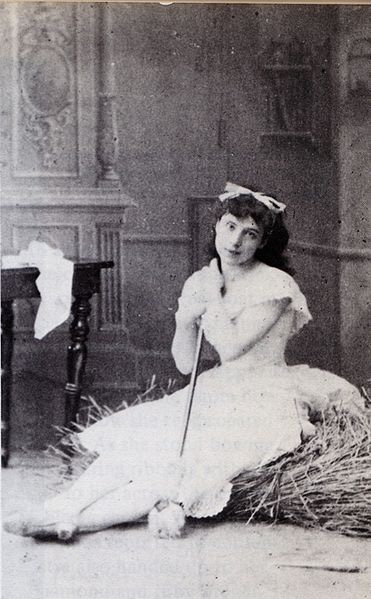
Mariinsky/Imperial Ballet, Russia, 1885. Staged and choreographed by Lev Ivanov and Marius Petipa after Taglioni, to the score by Hertel. Cast: Virginia Zucchi (Lise, pictured left), Pavel Gerdt (Colas). Notated and part of the Sergeyev Collection. Premiered 26th December [N.S] (16th December on the Julian calendar).
Bolshoi Theatre, Moscow, Russia, 1903. Staged by Alexander Gorsky after Ivanov/Petipa, to the score by Hertel but with additional pieces of music. Premiered 20th December [N.S] (7th December on the Julian calendar).
Pavlova’s Company, London, England, 1912. Abridged version staged by Anna Pavlova after Ivanov/Petipa to the Hertel score. Cast: Anna Pavlova (Lise), Laurent Novikov (Colas), Enrico Cecchetti (Widow Simone).
Mordkin Ballet, New York, 1938. Staged by Mikhail Mordkin after Ivanov/Petipa/Gorsky to the Hertel score. Cast: Lucia Chase (Lise), Dimitri Romanoff (Colas), Mikhail Mordkin (Widow Simone)
Ballet Theatre (American Ballet Theatre), 1940. Staged by Bronislava Nijinska after Ivanov/Petipa/Gorsky to the Hertel score. Cast: Patricia Bowman (Lise), Yurek Shabelevsky (Colas), Edward Caton (Widow Simone).
Royal Ballet, Royal Opera House, London, England, 1960. Staged and choreographed by Frederick Ashton to Hérold’s score. Cast included Nadia Nerina (Lise), David Blair (Colas), Stanley Holden (Widow Simone), Alexander Grant (Alain). Premiered 28th January.

Dancers of Lise and Colas (A-Z)
Note: This list is not fully comprehensive.
LISE
Nina Ananiashvili (born 1963), with the Royal Ballet, the American Ballet Theatre, and the Bolshoi Ballet in Ashton’s production
Alexandra Balashova (1887-1979), danced at a benefit performance for victims of the Russian famine at the Paris Opera on 23rd February 1922
Irina Baranova (1919-2008), with American Ballet Theatre
Patricia Bowman (1908-1999), originated the role in the 1940 Ballet Theatre production
Jane Burn (born 1973), with the Royal Ballet in Ashton’s production
Lucia Chase (1897-1986), with the Mordkin Ballet
Yuhui Choe (born 1986), with the Royal Ballet in Ashton’s production
Alina Cojocaru (born 1981), with the Royal Ballet in Ashton’s production
Lesley Collier (born 1947), with the Royal Ballet in Ashton’s production
Laura Connor (born c.1950), with the Royal Ballet in Ashton’s production
Helen Crawford (born c.1980), with the Royal Ballet in Ashton’s production
Wendy Ellis (born 1951), with the Royal Ballet in Ashton’s production
Fanny Elssler (1810-1884), with the Paris Opera Ballet and Imperial/Mariinsky Ballet
Sofia Fedorova (1879-1963), with the Bolshoi Ballet in Gorsky’s production
Mara Galeazzi (born 1973), with the Royal Ballet in Ashton’s production
Dorothée Gilbert (born 1983), with the Paris Opera Ballet in Ashton’s production
Belinda Hatley (born c.1970), with the Royal Ballet in Ashton’s production
Margaret Illman (born 1965), with the Rome Opera Ballet in Ashton’s production
Maria Jacob (fl.1836-1849), with the Paris Opera Ballet in Aumer’s production
Ann Jenner (born 1944), with the Royal Ballet in Ashton’s production
Marilyn Jones (born 1940), with the Australian Ballet in Ashton’s production
Karen Kain (born 1951), with the National Ballet of Canada in Ashton’s production
Tamara Karsavina (1885-1978), with the Imperial/Mariinsky Ballet, and later mime assistant for Ashton’s 1960 production
Alexandra Kemmerer (fl.1861-1879), with the Imperial/Mariinsky Ballet pre-1885
Gelsey Kirkland (born 1952), with the American Ballet Theatre in Nijinska’s production
Mathilde Kschessinskaya (1872-1971), with the Imperial/Mariinsky Ballet
Zsuzsa Kun (1934-2018), with the Hungarian National Ballet in Ashton’s production
Sarah Lamb (born 1980), with the Royal Ballet in Ashton’s production
Brenda Last (born 1938), with the Royal Ballet in Ashton’s production
Tina LeBlanc (born 1966), with the Joffrey Ballet in Ashton’s production
Kerstin Lidström (born c.1944), with the Royal Swedish Ballet in Ashton’s production
Svetlana Lunkina (born 1979), with the Bolshoi Ballet in Ashton’s production
Natalia Makarova (born 1940), with the American Ballet Theatre in Nijinska’s production
Roberta Marquez (born 1977), with the Royal Ballet in Ashton’s production
Pauline Montessu (1803-1877), originated the role in Aumer’s 1828 production
Laura Morera (born 1977), with the Royal Ballet in Ashton’s production
Gillian Murphy (born 1979), with the American Ballet Theatre in Ashton’s production
Nadia Nerina (1927-2008), originated the role in Ashton’s 1960 production
Marianela Nuñez (born 1982), with the Royal Ballet in Ashton’s production
Arantxa Ochoa (born 1974), with the Pennsylvania Ballet in Ashton’s production
Natalia Osipova (born 1986), with the Royal Ballet in Ashton’s production
Solveig Østergaard (born 1939), with the Royal Danish Ballet in Ashton’s production
Annette Page (1932-2017), with the Royal Ballet in Ashton’s production
Merle Park (born 1937), with the Royal Ballet in Ashton’s production
Anna Pavlova (1881-1931), with the Imperial/Mariinsky Ballet and her own touring company
Olga Preobrazhenskaya (1871-1962), with the Imperial/Mariinsky Ballet
Anna Prikhunova (1830-1887), with the Imperial/Mariinsky pre-1885
Xiomara Reyes (born 1973), with the American Ballet Theatre in Ashton’s production
Nicola Roberts (born c.1960), with the Royal Ballet in Ashton’s production
Sonia Rodriguez (born 1972), with the National Ballet of Canada in Ashton’s production
Gislinde Skroblin (born 1944), with the Bavarian State Ballet in Ashton’s production
Meriç Sümen (born 1943), with the Turkish State Ballet in Ashton’s production
Mademoiselle Theodore (Marie-Madeleine Crespé, 1759-1799), originated the role of Lison
Fiona Tonkin (born 1961), with the Australian Ballet in Ashton’s production
Ashley Tuttle (born 1971), with the American Ballet Theatre in Ashton’s production
Maria Medina Viganò (?-1833) at the Teatro San Samuele, Venice, in 1793
Sarah Wildor (born 1972), with the Royal Ballet in Ashton’s production
Miyako Yoshida (born 1965), with the Royal Ballet in Ashton’s production
Virginia Zucchi (1849-1933), with the Berlin Ballet in Taglioni’s production, and originated the role in the 1885 Imperial/Mariinsky Ballet production
COLAS
Carlos Acosta (born 1973), with the Royal Ballet in Ashton’s production
Frank Augustyn (born 1953), with the National Ballet of Canada in Ashton’s production
Mikhail Baryshnikov (born 1948), with the American Ballet Theatre in Nijinska’s production
Maxim Beloserkovsky (born c.1972), with the American Ballet Theatre in Ashton’s production
David Blair (1932-1976), originated the role in Ashton’s 1960 production
Andrei Bolotin (born 1978), with the Bolshoi Ballet in Ashton’s production
Heinz Bosl (1946-1975), with the Bavarian State Ballet in Ashton’s production
Fernando Bujones (1955-2005), with the Royal Ballet in Ashton’s production
Alexander Campbell (born 1986), with the Royal Ballet in Ashton’s production
Stuart Cassidy (born c.1970), with the Royal Ballet in Ashton’s production
Ricardo Cervera (born c.1975), with the Royal Ballet in Ashton’s production
Michael Coleman (born 1940), with the Royal Ballet in Ashton’s production
Ángel Corella (born 1975), with the American Ballet Theatre in Ashton’s production
Charles Didelot (1767-1837), at the Pantheon Theatre, London
Imre Dózsa (born 1941), with the Royal Swedish Ballet in Ashton’s production
Wayne Eagling (born 1950), with the Royal Ballet in Ashton’s production
Ferdinand (Jean La Brunière de Médicis, 1791-1837), with the Paris Opera Ballet in Aumer’s 1828 production
Sergei Filin (born 1970), with the Bolshoi Ballet in Ashton’s production
Pavel Gerdt (1844-1917), with the Imperial/Mariinsky Ballet pre-1885 and originated the role in the 1885 Imperial/Mariinsky Ballet production
Dmitry Gudanov (born 1975), with the Bolshoi Ballet in Ashton’s production
Antonio Guerra (1810-1846), at the Teatro dei Fiorentini, Naples, Italy, in 1825
Martin Harvey (born 1978), with the Royal Ballet in Ashton’s production
Eugène Hus (1758-1823), originated the role of Colin
Lev Ivanov (1834-1901), with the Imperial/Mariinsky Ballet pre-1885
Stephen Jefferies (born 1951), with the Royal Ballet in Ashton’s production
Niels Kehlet (born 1938), with the Royal Danish Ballet in Ashton’s production
Johan Kobborg (born 1972), with the Royal Ballet in Ashton’s production
Marinette Launer (?-1853), originated the role in Aumer’s 1828 production
Bryan Lawrence (1936-2017), with the Australian Ballet in Ashton’s production
Nicolas Le Riche (born 1972), with the Paris Opera Ballet in Ashton’s production
Nikolai Legat (1869-1937), with the Imperial/Mariinsky Ballet
Brian Maloney (born c.1980), with the Royal Ballet in Ashton’s production
Kenneth Mason (1942-2005), with the Royal Ballet in Ashton’s production
David McAllister (born 1963), with the Australian Ballet in Ashton’s production
Steven McRae (born 1985), with the Royal Ballet in Ashton’s production
Irek Mukhamedov (born 1960), with the Royal Ballet in Ashton’s production
Vadim Muntagirov (born 1990), with the Royal Ballet in Ashton’s production
Vaslav Nijinsky (1889-1950), with the Imperial/Mariinsky Ballet
Laurent Novikov (1888-1956), with Anna Pavlova’s touring company
Rudolf Nureyev (1938-1993), with the Royal Ballet in Ashton’s production
Raffaele Paganini (born 1958), with the Rome Opera Ballet in Ashton’s production
David Palmer (born c.1961), with the Joffrey Ballet in Ashton’s production
Johan Persson (born c.1970), with the Royal Ballet in Ashton’s production
Lucien Petipa (1815-1898), with the Paris Opera Ballet
Ivan Putrov (born 1980), with the Royal Ballet in Ashton’s production
Dmitri Romanoff (1907-1994), with the Mordkin Ballet
Viktor Rona (1936-1994), with the Hungarian National Ballet in Ashton’s production
Viacheslav Samodurov (born 1974), with the Royal Ballet in Ashton’s production
Bruce Sansom (born 1963), with the Royal Ballet in Ashton’s production
Yurek Shabelevsky (1911-?), originated the role in Nijinska’s Ballet Theatre production
Victor Smoltsov (1900-1976), danced at a benefit performance for victims of the Russian famine at the Paris Opera on 23rd February 1922
Thiago Soares (born 1981), with the Royal Ballet in Ashton’s production
Piotr Stanczyk (born c.1975), with the National Ballet of Canada in Ashton’s production
Ethan Stiefel (born 1973), with both the Royal Ballet and American Ballet Theatre in Ashton’s production
Vasily Tikhomirov (1876-1956), with the Bolshoi Ballet in Gorsky’s production
Salvatore Viganò (1769-1821), at the Teatro San Samuele, Venice, in 1793
David Wall (1946-2013), with the Royal Ballet in Ashton’s production
Sources
Beaumont, Cyril W. (2020 reprint, originally 1930). A History of Ballet in Russia. Noverre Press, Hampshire, England.
Beaumont, Cyril W (1956). The Complete Book of Ballets. Putnam, London, England.
Guest, Ivor (2006). The Paris Opera Ballet. Dance Books, Alton, Hampshire, England.
Guest, Ivor (1966). The Romantic Ballet in Paris. Pitman and Sons, London, England.
Étienne-Dominique Bercher (French): https://www.comedie-francaise.fr/fr/artiste/dauberval#
Jean Bercher (French): https://cesar.huma-num.fr/cesar2/people/people.php?fct=edit&person_UOID=100270
Ashton Foundation- La fille mal gardée: http://www.frederickashton.org.uk/fille.html
ROH Database entries for La fille mal gardée: https://www.rohcollections.org.uk/production.aspx?production=1721&row=0
Small Ballet Encyclopaedia on La fille mal gardée: http://www.ballet.classical.ru/d_malgardee.html
 Madeleine's Stage