In 1953, the British Empire was preparing for the coronation of their new Queen, Elizabeth II. And the Royal Ballet was no different.
Frederick Ashton’s ballet Homage to the Queen united the top dancers of the company in a marvellous pièce d’occasion. The ballet premiered on the 2nd June 1953, the same day as Elizabeth II’s coronation.
The Royals at the Ballet
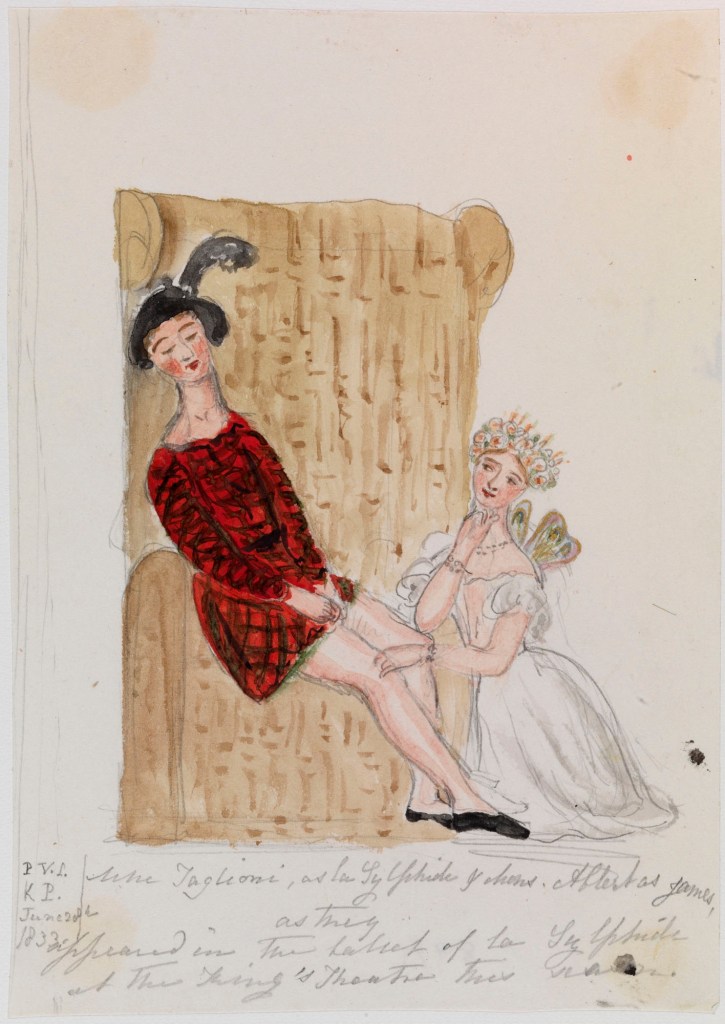
Before the 1956 Royal Charter that would turn the Sadler’s Wells Ballet into the Royal Ballet, the Royals could still be seen at the ballet. Queen Elizabeth’s female predecessor, Queen Victoria, was a noted fan of the ballet. Archived among the Royal Collections are sketches of Marie Taglioni, drawn by the young Victoria.
As Britain had no national ballet company, appearances were sporadic. Adeline Genée, prima ballerina of the Empire Theatre at the turn of the 20th century, was the closest thing Britain had to a ‘national ballerina’. Over a century later, in 2022, the Duchess of Cornwall would be shown a pair of Genée’s ballet slippers during a visit to the Royal Academy of Dance’s Centenary Exhibition.
In 1938 Queen Elizabeth (the Mother of our current Queen) attended the British premiere of Ninette de Valois’ ballet Checkmate. In 1939 Dowager Queen Mary attended the premiere of the Vic-Wells Ballet’s first full production of The Sleeping Princess. On both occasions student Beryl Grey would present a bouquet to the Royal Attendee.
The reopening of the Royal Opera House following the Second World War would happen in 1946, when a new production of Sleeping Beauty was premiered, led by Margot Fonteyn and Robert Helpmann. In attendance were Queen Elizabeth, King George, Princesses Elizabeth and Margaret, and Dowager Queen Mary.

2nd June 1953
The coronation night programme began with Margot Fonteyn and guest artist Robert Helpmann leading Act II of Swan Lake. Following this was a relay of the Queen’s speech, and then a performance of Frederick Ashton’s Façade. Façade originally premiered in 1931, and was revived for the Vic-Wells Ballet in 1935. And then, after this, came Homage to the Queen.
Ashton knew he had four ballerinas to work with: Margot Fonteyn, Nadia Nerina, Beryl Grey and Violetta Elvin. After deliberating over the Seasons and the Queens, he settled upon the elements. As such, Nerina was cast as the Queen of Earth, Elvin as Water, Grey as Fire and Fonteyn as Air. Their consorts were Alexis Rassine, John Hart, John Field and Michael Somes respectively.
Each couple had an entrée that showed off their talents. The Earth choreography appropriately used terre à terre movements, where the feet barely leave the ground. Water used soft lyrical arm movements, utilising Elvin’s sinuous arms. Fire aimed to be the most dangerous, using swift turns. And finally, the Air pas de deux featured Fonteyn and Somes’ skills in lifts.
The four sections are succeeded by the apotheosis, which are frequently used in pièce d’occasions, and usually features the dancers coming together. This apotheosis features the symbolic passing of the sceptre and the orb, the historical treasures used during a coronation.
The score for the ballet was commissioned, and written by Malcolm Arnold. Ashton sent Arnold a brief layout of what he wanted in the score. At the time, Ashton was considering naming each section after a British Queen Regnant, and as such his notes use the sections Elizabeth I, Anne, Victoria and Elizabeth II.
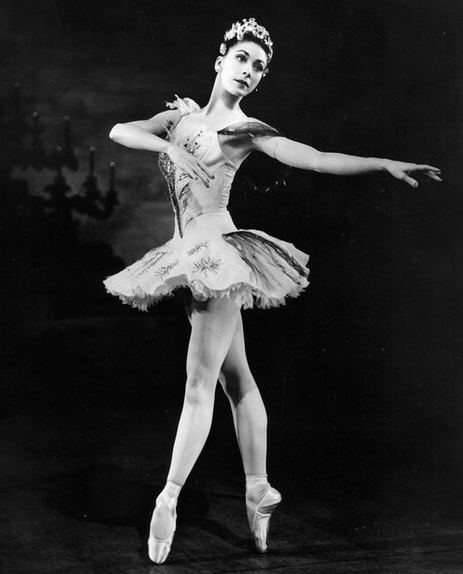
From the accounts of the dancers, the ballet seemed to be a nice one. Beryl Grey wrote that ‘Fred’s choreography meant that each dancer’s talents were fully displayed’, and that the dancers ‘appreciated Malcolm Arnold’s specially composed music’.
The differing opinions were about the designs, which were done by Oliver Messel. Messel was a celebrated designer who had worked with the company before, most notably on the 1946 production of Sleeping Beauty. While Beryl Grey liked the designs, others did not. Peter Williams, founder of magazine Dance and Dancers, suggested that a redesign could give the ballet a longer shelf life, and make it a recurring pièce d’occasion.
This did not happen, and the (not complete) Royal Opera House performance database lists the last full performance of the ballet being in 1958. After this, the Queen of the Air section would be performed, quite notably in December 1994, as the performances were dedicated to Michael Somes, who had died in November.
On the 5th June 2006, a reimagined production of Homage to the Queen premiered, dedicated to Queen Elizabeth for her 80th birthday. This production utilised Ashton’s choreography for Air, with répétiteur Christopher Newton staging that section, the beginning entrée, and the apotheosis. The choreography for the other 3 sections was passed to three choreographers associated with the Royal Ballet and its sister company, the Birmingham Royal Ballet: David Bintley (Earth), Michael Corder (Water) and Christopher Wheeldon (Fire). Designs were done by Peter Farmer, another celebrated designer who had worked extensively on ballet productions.
The ballet kept the tradition of showing off the talents of the dancers. Leanne Benjamin and Federico Bonelli lead Earth, Alina Cojocaru and Johan Kobborg Water, Sarah Lamb and Gary Avis Fire, and Darcey Bussell and David Makhateli Air. This production was revived in 2008, and was performed on the Royal Ballet’s tour to Japan the same year. And then, again, it fell from the repertoire.
Nursery Suite
By the 1980s, Frederick Ashton had slowed down his choreographic ventures. His last new ballet was 1986’s Nursery Suite, which was first presented on the 21st April 1986. The 60th Birthday of Queen Elizabeth.
Nursery Suite was made for the Royal Ballet School, and premiered at the ‘Fanfare for Queen Elizabeth’ Gala Performance at the Royal Opera House. The score is the 1st, 3rd, 5th and 7th movements of Edward Elgar’s Nursery Suite, premiered in 1931 and dedicated to the newly-born Princess Margaret, her older sister Princess Elizabeth, and their mother the Duchess of York. This music had previously been used for a 1932 ballet of the same name by Ninette de Valois, but that was not a marked success.
The two main roles are that of Elizabeth (Lilybet), and Margaret Rose. These roles were originated by Zara Deakin and Susannah Jones, who both was commended for their acting. The ballet shows quite clearly the difference in the pairs’ upbringing: Lilybet was to be Queen, and Margaret Rose was not. When four boys came along in a wagon, Margaret Rose joined them, and Lilybet was left to ponder on her future role. And Ashton’s genius managed to keep the ballet from being over-sentimental, his building of characters as strong as ever.
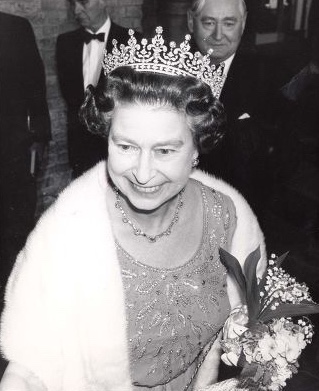
The Queen and her late husband the Duke of Edinburgh were in attendance at the birthday gala, which brought together both ballet and opera. They were joined by multiple family members, including the Queen Mother, Prince Charles, Princess Diana, Princess Anne, Prince Andrew and his fiancée Sarah Ferguson, Prince Edward, and Princess Margaret.
Like Homage to the Queen, Nursery Suite was revived in 2006. An excerpt was performed at the Royal Ballet’s 75th Anniversary Gala by Olivia Cowley and Emma Maguire.
Princess Margaret was a devoted fan of the ballet, becoming friends with Margot Fonteyn and Rudolf Nureyev, and serving as President of the Royal Ballet. One of her last public appearances was at the September 2001 Westminster Abbey memorial service for Ninette de Valois, who had died in March 2001.
Queen Elizabeth has continued to attend ballet events over the years, as have other members of the Royal Family. In 2002 Zenaida Yanowsky and Roberto Bolle performed an excerpt from Swan Lake as part of the Prom at the Palace, and Golden and Diamond Jubilee Galas were held at the Royal Opera House in 2002 and 2012 respectively. For the Platinum Jubilee the Royal Ballet will join a star-studded line up at the Platinum Party at the Palace, to celebrate a once in a lifetime jubilee.
Sources
Grey, Beryl (2018). For the Love of Dance. Oberon Books, London, England.
Fonteyn, Margot (1976). Autobiography. Alfred A. Knopf, New York, USA.
Vaughan, David (1999). Frederick Ashton and his Ballets, Revised Edition. Dance Books, England.
ROH Database listing for Homage to the Queen’s premiere: https://rohcollections.org.uk/performance.aspx?performance=11911&row=0
Frederick Ashton Foundation’s page on Ashton’s Ballets: http://www.frederickashton.org.uk/ballets.html
A 2002 BBC News Article about Princess Margaret and Ballet: http://news.bbc.co.uk/1/hi/uk/1100791.stm
 Madeleine's Stage