On the 3rd September 1939, the United Kingdom and France officially declared war on Nazi Germany. Two days earlier, Nazi Germany had invaded Poland. This would begin the start of the Second World War, the deadliest military conflict in history.
900 miles away from Warsaw, a ballet company was disembarking from a train, which had taken them from Liverpool to Leeds. The previous evening, a Saturday, a trial blackout of city lights had taken place in Liverpool. A dancer in the company had heard a porter shouting ‘war declared’ as the train doors shut. But it wasn’t until the company arrived in Leeds that the reality set in. The country was at war.
The Provinces
It was Margot Fonteyn who heard the porter shouting. The young dancer and ballerina of the company mentioned it to others in her carriage, but they thought she was mistaken. The porter must’ve been shouting ‘All clear!’ they told her. Two and a half hours later, when their train arrived in Leeds, they were told war had indeed been declared.
Most of the company, however, was too young to realised the impact of this. The company too, was young, and had never had to navigate itself through a war. Would theatres be closed down? Would people be called up? Would they be able to dance at all? It was sobering news.
Fred Ashton was silent and gloomy. Constant Lambert, untypically, was at a loss for an amusingly highbrow comment to fit the occasion, and even [Robert] Helpmann could think of no way to turn the situation into absurdity.
Margot Fonteyn, Autobiography, P73
Of course, the government had more important things to tend to immediately after the declaration, so all they could do was wait. It was decided they should stay the night in Leeds. At the time the company were touring ‘The Provinces’, which in theatre talk can refer to any theatre outside London. These tours were common for the company, and would become more common during the war.
Back in London, the students at the fledgling Sadler’s Wells Ballet School were going through a similar upheaval. In her autobiography, Beryl Grey, a student at the school at the time, writes that the school was closed shortly after the declaration, but, not for very long.
Within three weeks of the outbreak of war my parents, however, received a card from the Wells secretary. The school was to reopen at Sadler’s Wells on September 25th and I was expected to attend daily.
Beryl Grey, For the Love of Dance, P14
Grey also notes that, excluding strict blackout rules, London returned to a relatively normal atmosphere during those first few months of war.
In Leeds, the Company’s night in a local hotel was not without chaos. The air raid sirens sounded in the night, and they were all sent down to the cellar. Fonteyn writes that her and roommate Pamela May, both young dancers, were unable to find their dressing gowns in the dark, and decided to go down wrapped in their duvets. Upon seeing them, Ninette de Valois sent them back to go get the dressing gowns.
Pamela and I, sharing a room, were awakened in the night by the eerie sirens giving an air raid warning. Of course I panicked, thinking that a bomb was on its way to me, personally, at that very minute…In the dusty cellar, which smelt of stake beer, a couple of hours passed while nothing at all happened to the city. Afterwards I felt extremely foolish about my hysterical behaviour.
Margot Fonteyn, Autobiography, P74
The company returned to London the next day.
The ‘Phoney War’
The ‘Phoney War’, as it has been named, is defined as the first eight months of the Second World War. During this time, little actual warfare took place. For the British populace, air raids would cause the most destruction, but these had not begun in earnest. The Blitz, the worst of this bombing, wouldn’t start until September 1940. But a year earlier, both the Allies and the Axis were worried about the loss of aircraft that raids caused, and feared retaliation for bombing and killing civilians.
When the Company arrived in London they were disbanded. The government were closing all forms of entertainment for the time being. So, as with the school, there was no point for them to be open. Children were to be evacuated to the countryside, where they would be safe from bombs, and adults were to contribute to the war effort. It was unclear to everyone if or when theatres would reopen.
But it didn’t even take a month for the Company to begin touring again. After 14 days with no rehearsing, the dancers were thrust right back onto the stage, which, as you can imagine, caused sore muscles and aching feet. This tour, which began in Cardiff and continued to places like Leicester, Brighton, Nottingham and Cambridge, allowed no dancer to slack off. Many of them would be performing in 7 shows a week, while staying in cramped digs and living off a diet that most likely consisted of what food they could find. This performance schedule was to last for most of the war.
A lot of these performances were for soldiers, and not all in the military were appreciative. Fonteyn recounts soldiers leaving the theatre during the quietest moments of Les Sylphides, all while Constant Lambert (the musical director and conductor) and Hilda Gaunt (the rehearsal pianist) played valiantly, providing musical accompaniment on two pianos.
One night, in our theatrical lodgings, over cold meat, apple pie and hot tea, Fred Ashton announced that he was going to read the Bible from beginning to end, and that by the time he finished it the war would be over. Finding some passages monotonous and heavy-going, he made a further announcement: he would read it aloud to us. Billie [William] Chappell protested, saying: “Freddie, you can’t do that to your friends.” Nevertheless, Freddie did, but he miscalculated by about four years, and was to read a great many other books before the Holocaust ceased.
Margot Fonteyn, Autobiography, P75
Dante Sonata
In December 1939 the Sadler’s Wells Ballet returned to their namesake theatre. Theatrical life in London was inching back towards normality, though the fear of air raids remained. Theatre programmes were getting smaller, due to paper rationing, and air raid warnings were printed in every respectable programme.
Notice
If an Air Raid Warning is received during the performance, those desiring to leave the Theatre may do so, but the performance will continue. The Nearest Shelter is next to British and Colonial Motors, Upper St. Martin’s Lane. Directions will be given by the attendants.
The above warning comes from a 1943 Sadler Wells Ballet programme, when they were performing at the New Theatre London (today known as the Noël Coward Theatre). Though the air raids during the Blitz were devastating, Fonteyn wrote that she ‘never heard of anyone getting up from his or her seat to leave the theatre because of an air-raid alert’.
And part of the reason for this is that the Company didn’t stop creating. Frederick Ashton was making new ballets, and when he was called up the Australian Robert Helpmann took over as choreographer for the Company. During that London season of 1939-1940, it was Ashton’s Dante Sonata that kept the crowds coming in.
Dante Sonata pins two groups against each other, with these groups gaining identifiable names after the premiere of the production. One group, led by Margot Fonteyn and Michael Somes with Pamela May and Julia Farron, came to be known as the Children of Light, with the opposing group (June Brae, Joy Newton, Robert Helpmann and a corps de ballet) becoming the Children of the Darkness. Neither group prevailed during this conflict, a marvel considering the patriotism that was sweeping the country. Though Ashton discouraged a literal take of the ballet, preferring an abstract and free interpretation, it was a piece inspired by war.
It was created in the modern dance idiom in bare feet, and we were forever coaxing splinters out of our bodies, since there was a lot of dragging people across the stage and no one ever thought to lay a covering over the ancient wooden floorboards of English provincial theatres. But we felt so deeply the passion of Ashton’s heart-cry for humanity that we cared nothing for the splinters.
Margot Fonteyn, Autobiography, P79
The music for this ballet was Franz Liszt’s Après une lecture du Dante: Fantasia quasi Sonata, originally published in 1856. Orchestrations were done by the Company’s Music Director Constant Lambert, who played piano for all the rehearsals to build the exact picture of what was happening on stage, greatly helping his orchestrations.

Design was done by Sophie Fedorovitch, a frequent collaborator of the company. She too joined the company in rehearsals (which were done in between performances of the provincial tour), pinning material to May and Fonteyn and having them run around to see what effect it created. The joint forces of Ashton, Lambert and Fedorovitch gave the ballet a feel of being a Company ballet, not just one person’s vision; as Lambert put it some time after the premiere ‘it has a visual-cum-musical unity which could only have been achieved by this form of collaboration’.
23rd January 1940 brought about the premiere of Dante Sonata. It became a success, although the right phrase to describe it is probably an ’emotional experience’. It became a ballet that one had to have seen, a necessity to theatregoers in those early months. People returned to see it again and again. A year ago, in January 1939, the Company were rehearsing to premiere The Sleeping Beauty, a grand fairytale story of joy; now, their success was a ballet that was therapeutic, and cathartic. They were adapting to theatrical existence during a war.
Margot Fonteyn describes Dante Sonata as a ballet ‘impossible to reproduce after the war, danced by a generation too young to understand its time of creation’. David Vaughan writes that, when revived in 1946, its ‘power had evaporated’. It’s hard for me to personally comprehend how much must’ve changed during those wartime years, but it’s clear from everyone who writes of it that Dante Sonata was a work that belonged, and owed its existence to, the ‘Phoney War’.
The Hague
Once the London season was over, another provincial tour was launched, and then another short London season, in which a new Ashton ballet (The Wise Virgins) premiered. Then, came danger. George Lloyd, 1st Baron Lloyd and Head of the British Council, had decided the Company should tour The Netherlands.
Now, there’s nothing wrong with The Netherlands, but, in 1940, a country that bordered Germany was not an ideal place to be. The Netherlands had declared neutrality, but considering Hitler’s track record for invading countries, it was still a risky decision.
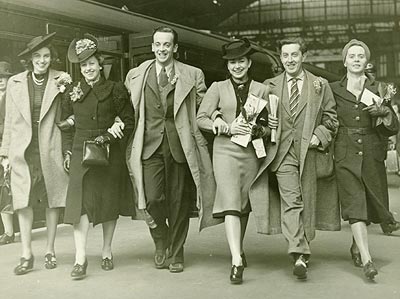
The Company set off from King’s Cross in early May, taking a train and then a boat across the North Sea. They disembarked in Rotterdam and then headed for The Hague, where they were to give their opening night Gala Performance at the Koninklijke Schouwburg (Royal Theatre).
That Gala Performance went well. Among the works performed were Checkmate and Dante Sonata, and tulips were showered down on the company as they took their curtain call. In her autobiography Fonteyn suspects that the sightseeing British company, so taken with the scenery after months of blackouts, roused the spirits of the Dutch. Whatever it was, the British Council must’ve been pleased with the friendly reception.
That friendly reception lasted until the next location of the tour. Hengelo, a town closer to the German border, showed the signs of defence preparation: barbed-wire fortifications and blocked roads. They then performed in Eindhoven and Arnhem. And it was in a Dutch hotel that they learnt that British Prime Minister Neville Chamberlain had resigned. But what was going on at home was of less importance of them, as big things were going on just half an hour away from Arnhem: over the border, the Germans were mobilising.
The gravity of the situation became more obvious each day. The generation above mine reacted according to their different temperaments. De Valois showed her anxiety only when caught off guard. Constant Lambert tried to look cheerfully fatalistic. Ashton’s hyper-sensitive imagination worked like an antenna to pick up new signs of the impending German invasion. Helpmann, the court jester, wrapped truth in humour in order to break the tension he perhaps felt more than anyone else.
Margot Fonteyn, Autobiography, P75
Instead of staying at a hotel in Arnhem, the company were bundled back onto the bus to The Hague. They arrived at their hotel in the early hours of the morning. But they didn’t get much sleep. Hubbub started in the hotel corridors as those who awoke first rushed to tell their comrades that the German invasion had started, and they were parachuting into the city.
The dancers, bundled in dressing gowns, went up onto the roof of the hotel to watch as dawn brought planes and parachuters. Soon enough they were herded down to the cellars by De Valois, and when they did try to venture out into the streets, Ashton and Helpmann were nearly hit by stray bullets, causing an order to stay in the hotel. Only de Valois and Lambert left, to discuss with the British Ambassador and the Dutch Authorities what could be done.
It wasn’t until the following evening that two buses arrived for them. After spending the morning exercising to a B.B.C radio show, the company had to figure out what they could take with them. The answer: not much. Scenery, costumes and scores for ballets had to be left behind, as did most of their clothes and belongings. It’s said de Valois left in Ashton’s dinner jacket, as he could not bear to leave it behind.
The buses drove through the night, the company guarded by Dutch soldiers, who would ride along on the buses with them. Despite the language barrier, they were able to communicate with one of them, and learn that he was Jewish, something that highlighted the reality of the German invasion for them.
After a long stop-start journey, they spent the day at a rural château, which was being used to house refugees. The house was crowded, and rounds of gunfire would be heard every so often. The men of the company played football against the Dutch soldiers, but there was little anyone could do until nightfall. And when it go to nightfall they boarded the buses, and set off on another stop-start journey, before finally getting to IJmuiden.
IJmuiden is a port city in the province of North Holland. When there they found an cargo boat, HMS Dotterel (built in 1936), already overcrowded with refugees. They were able to board, but conditions were dire. Straw had been laid down on the floor of the hold, and that was all there was to sleep on. The boat sped away from the harbour, leaving the Netherlands as quick as it could.
The Royal Family of the Netherlands also left the port of Ijmuiden around the same time (12th/13th May). Some left on HMS Codrington, while Queen Wilhelmina left on HMS Hereward. A lot of these boats headed for Harwich, a port town in the English county of Essex. They left behind a fallen country, overrun by invaders.
Upon arriving in Harwich, they weren’t allowed to land immediately. But again, de Valois fought for her company, and soon enough their feet were back on English soil. A train took them back to London, and then they were home.
Back home at long last I recounted it all to my mother, then fell fast asleep for twenty-four hours.
Margot Fonteyn, Autobiography, P78
The End of the Phoney War
On the same day the Netherlands was invaded, the Germans launched their invasions of France, Luxembourg and Belgium. This day, the 10th May, is considered the end of the Phoney War. Actual warfare would devastate countries, and the Germans would occupy large parts of Europe.
The majority of the Netherlands surrendered to Nazi Germany on the 14th May, and the entire country had fallen by the 17th. A government-in-exile was set up in London, and those who hadn’t managed to get away spent 5 years under German occupation. Those who were deemed ‘undesirable’ and ‘unclean’ were deported to concentration camps (roughly 75% of their Jewish population were killed).
The Sadler’s Wells Ballet narrowly escaped a situation that would’ve been a lot more difficult to navigate. And those young dancers, who were unsure of what the war would bring, certainly knew now. Just days after their escape from the Netherlands, Margot Fonteyn celebrated her 21st birthday. And she felt this horrifying escape had undoubtedly made the Company a more tightly-knit family.
During the war the Sadler’s Wells Theatre was used as a refuge for those who had been left homeless during air raids. The Ballet company continued to tour the provinces and do seasons in London (at theatres like the New Theatre), with a rigorous schedule. Their men were called up, balletomanes graciously brought dancers food to help with their diets, but they kept creating, and kept performing. To the surprise of even de Valois, the company survived the war.
Sources
Daneman, Meredith (2005). Margot Fonteyn. Penguin Books, London, England.
Fisher, Hugh (1954). The Story of the Sadler’s Wells Ballet. Adam and Charles Black Ltd., London, England.
Fonteyn, Margot (1976). Autobiography. Alfred A. Knopf, New York, USA.
Grey, Beryl (2018). For the Love of Dance. Oberon Books Ltd., London, England.
Vaughan, David (1999). Frederick Ashton and his Ballets – Revised Edition. Dance Books, London, England.
Frederick Ashton Foundation Page on Dante Sonata: http://frederickashton.org.uk/dante.html
 Madeleine's Stage