
I can confidently say I am someone who knows very little about opera. I know some of the most famous operas, some of the most famous music, and some of the most famous performers. I had never seen an opera live before going to see Tosca. But what I do know, is that I saw an incredible performance.
I wasn’t quite sure what to expect going into it. I was attending with someone who had seen it before, and had read the synopsis, as I didn’t want to consider myself lost (I had forgotten about the existence of surtitles). I had looked up a few clips of the opera on Youtube, and I felt that by the time I got the theatre I had a pretty good grasp of the plot. And I found that in the end, there were parts where I was so engrossed in the stage that I forgot to look at the surtitles, but I was still able to know what was going on.
The production, directed by Edward Dick, has contemporary elements, but they don’t feel out of place at all. Those touches of modern life blend seamlessly in with the Puccini music, and it all slots into place. The sets, designed by Tom Scutt, add to this. The sets I found really added to the feel of the setting of the opera. There’s a circular element throughout each act, and the majority of the set is placed within this circle. This results in the ability to move characters into the small, circular space, while simultaneously having the chorus move in the background. When there is a collision of both it creates a shatter of secrecy, something that really fits with the the of the opera.
Another thing the sets are is beautiful. I mainly speak of the sets for the 1st and 3rd Act, but they really give off the feel of Rome. The huge fresco of Mary Magdalene that’s being painted by Cavaradossi (seen above in the photo) is breathtaking, and the use of the scenery in the third act made Tosca’s ending feel instinctive, not like she’s moving because it’s what it says in the libretto.
The lighting design (by Lee Curran) also added to the atmosphere. It was dark, but thankfully not too dark that you couldn’t see, a problem which can often plague theatre productions. The darkness in this context helps, as it creates the closed off nature to boost the believability of the sets. In particular the lighting for the Te Deum scene, and the lighting for the prison in Act III were both gorgeous, and the use of votive candles fit the theme and was absolutely beautiful.
In regards to the costumes (designed by Fotini Dimou), they also blended the modern with the classic. It didn’t feel at any point like it was modern for the sake of being modern, it all felt natural. The movement by choreographer Maxine Braham complemented the scenery, particularly in the second act as Scarpia and Tosca move around the bed.
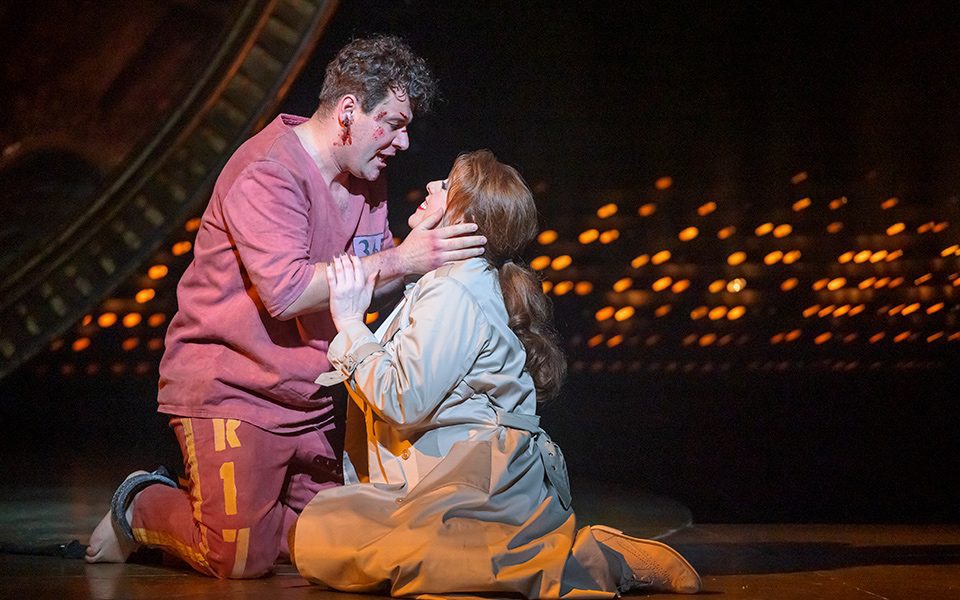
The cast was led by Giselle Allen (Tosca), Mykhailo Malafii (Cavaradossi) and Robert Hayward (Scarpia). All three were absolutely brilliant in their roles, and were able to play off each other. The humour of Tosca and Cavaradossi in the first act shone through, and Allen and Malafii were then able to switch so perfectly to the anguish of the third. Hayward was fear-inducing in his role. Sometimes you aren’t able to see a character, only a performer playing that character, but this didn’t happen here. The supporting cast and chorus were also of a high standard.
Overall, this production was the perfect introduction to opera. The opera’s big moments, such as the Te Deum and Cavaradossi’s third act aria (E lucevan le stelle), are show-stopping, but the whole opera is entertaining and dramatic. The wonderful mix of classic and modern provides a setting that suits the opera very well, and the cast truly make the opera feel so alive, and so fresh. I now want to see more operas, and will hopefully be able to see more of Opera North in the future.
Opera North’s Tosca continues in Leeds until March 2nd, then tours to Salford, Nottingham, Newcastle and Hull. Find out more here.
 Madeleine's Stage