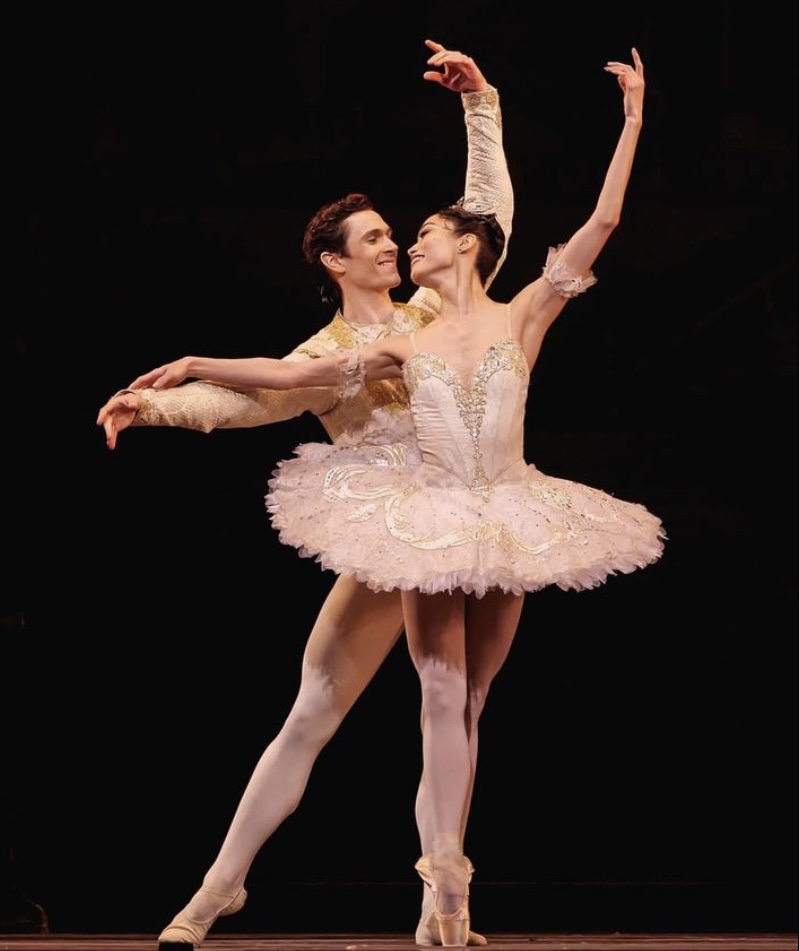
On the 4th March 2023 I visited the Royal Opera House to see the ballet Sleeping Beauty. This was my first time seeing this ballet live, although I had watched multiple videos of it, including some of the Royal Ballet’s current production. I knew I was going to see something good, I just didn’t know how incredible of a performance it would turn out to be.
This production of Sleeping Beauty is quite a classic one. Following the end of World War 2, the Sadler’s Wells Ballet were given a new home: the Royal Opera House. The first ballet presented at the Royal Opera House, at a reopening gala on the 20th February 1946, was Sleeping Beauty. A new production by Nicholas Sergeyev and Ninette de Valois had been produced for this event. In 2006 this staging was revived, and has been performed ever since.
Seeing the ballet live truly shows why it is one of the classics. We all probably know the plot of the fairytale, and I knew the general structure of the ballet, yet I still found myself being drawn in by the effects, the design, and most importantly the dancing. If I hadn’t have known this was a revival of the 1946 production, I don’t think I would’ve guessed: there is nothing that could be called ‘old’ about it. It still looks fresh, and is able to produce the same response from the audience as I imagine it did 77 years ago. I was particularly enchanted by the Panorama carriage; even though I had seen it on film, it was entrancing in real life.
The ballet is presented in a Prologue and Three Acts, but Acts II and III are performed together. The Prologue covers Aurora’s Christening, Act I Aurora’s 16th birthday, Act II the Awakening of Aurora, and Act III Aurora and Florimund’s Wedding.
At the performance I saw, the leading roles were danced by Fumi Kaneko (Aurora) and William Bracewell (Florimund). Kaneko was radiant in her role, one of the hardest in a ballerina’s repertoire. The Rose Adagio, a masterclass in balancing, can often overpower a dancer, but Kaneko stayed firmly in control, and earned thunderous applause for it. Throughout the acts she was absolutely magical, and totally believable in her role.
Bracewell too, was totally believable. I always see Florimund as a role that is pivotal to the story, but a character with little autonomy, (particularly in the Second Act, when he is mostly directed by the Lilac Fairy). However Bracewell made me see the Act in a different way. While Florimund is directed by the Lilac Fairy, Bracewell showed a side that was entranced by the vision of Aurora, something I hadn’t really picked up on before. His dancing in the Third Act was wonderful, and together Kaneko and Bracewell were lovely partners.
The Lilac Fairy was danced by Gina Storm-Jensen, who was strong is both dance and mime. The Royal Ballet’s Lilac Fairy variation is a tricky one, but Storm-Jensen looked confident and danced it very well. Hannah Grennell as Carabosse was brilliantly haughty. She seemed less of an old Carabosse, and more a young one who found glee in casting a curse, which was an interpretation I really enjoyed. Joining her was a pack of very nimble rats, who get a shoutout for leaping around the stage like they were on springs.
Alongside the Lilac Fairy, 5 other fairies at present at Aurora’s christening, and each of them get their own variation. These fairies are known by various names in various productions, but in the Royal Ballet production they are named: The Fairy of the Crystal Fountain (Annette Bulvoli), The Fairy of the Enchanted Garden (Yu Hang), The Fairy of the Woodland Glade (Ashley Dean), The Fairy of the Song Bird (Sophie Allnatt) and The Fairy of the Golden Vine (Yuhui Choe).
Each of the fairy variations was danced beautifully, and the dancers brought out the differences in each of their fairies well. They were assisted by cavaliers Harris Bell, Joseph Sissens, Benjamin Ella, Calvin Richardson, Taisuke Nakao and Luca Acri. The cavaliers were mostly in sync with each other, and did some wonderful jumping.
The wedding in Act III features some similar guests, coming to celebrate the marriage. These characters are lifted from fairytales, and a few of the pairs get their own dances. Red-Riding-Hood and the Wolf are the most well-known of these guests, and the others are Puss-in-Boots and the White Cat, the Bluebird and Princess Florine, and Florestan and his Sisters.
The last named of these was an addition by choreographer Frederick Ashton for the 1946 production, and uses music that was previously for the precious jewels variations. Benjamin Ella, Ashley Dean and Annette Bulvoli were a synchronised trio, fluidly managing the complicated arm movements that keep the characters joined together. Sophie Allnatt and Joshua Junker, dancing the White Cat and Puss-in-Boots, were lovely in their roles, and brought the comical movements of their characters well.
Ginevra Zambon and Joonhyuk Jun (as Red-Riding-Hood and the Wolf) were similar, and the small ballet students who came on stage as trees were heartily received by the audience. Luca Acri and Mariko Sasaki danced the Bluebird and Princess Florine, and were enchanting to watch. Acri flew high as the Bluebird in the famous variation, and Sasaki was neat and bird-like.
I can’t wrap this reflection up without mentioning the orchestra. Conducted by Koen Kessels, the music was brilliantly played. A lot of the music is familiar, and the orchestra play it every performance, but it still sounded fresh and new.
Overall, this production of Sleeping Beauty deserves its reputation as a brilliant one. The design of the production is gorgeous and luxurious, and the dancers of the Royal Ballet are brilliant performers. The ballet is truly brought to life in this production, and it is a magical experience.
The Sleeping Beauty returns to the Royal Opera House from the 6th May-6th June 2023.
 Madeleine's Stage