On the blog I’ve previously discussed the lives of some of the lesser-known dancers of the Ballet Russes, and I enjoyed looking into the lives of these dancers and learning more about them.
This time, I’d like to look at a similar topic, but with a dancer from the ranks of the 19th-century Paris Opera Ballet. Over the mid 19th-century the company had among their ranks some of the greatest ballerinas of the time: Marie Taglioni, Carlotta Grisi, Lucille Grahn, Fanny Elssler and many more. There are some dancers who were less well-known, and it’s one of those those dancers I will look at today.
The Sleepwalker
Pauline Montessu’s birth date has been given as both 5th June 1803 and 4th June 1805, but most sources agree she was born in Marseile. She was born as Pauline Euphrosine Paul, and was the younger sister of the celebrated dancer Antoine Paul (c.1798-1871), known professionally as just Paul. Paul became one of the top dancers of the Paris Opera Ballet, and was known as L’Aérien because of his jumps. As a young child, about the age of seven, she began dancing on stage in Lyon alongside her brother.
Montessu built off this experience enough to be accepted at the Paris Opera School of Dance, having followed her brother to Paris. She made appearances on the Opera Stage during her school years, but her official debut wouldn’t come until the 17th July 1820, at the age of either fifteen or seventeen. Her debut was well-received, and the Paris public found her dancing rather novel.
She was a ballerina at the Paris Opera from 1820-1836, and danced many roles during that time. These included:
- A role in the 1820 revival of Les Pages de Duc de Vendôme. The revival of this Jean-Louis Aumer ballet premiered on the 18th October 1820, and Montessu danced in a pas with her brother. A contemporary review by Castil-Blaze notes that many of the Opera’s artists appeared to dance in a divertissement that had little to do with the actual plot of the ballet.
- Flora in Jean-Baptiste Blache’s Mars et Vénus. Another revival, the Opera production premiered on the 29th May 1826. Her brother danced Zephyr, and the pair of them had a dance together in the 1 Act. This ballet stayed in repertory until 1837, and had over 100 performances.
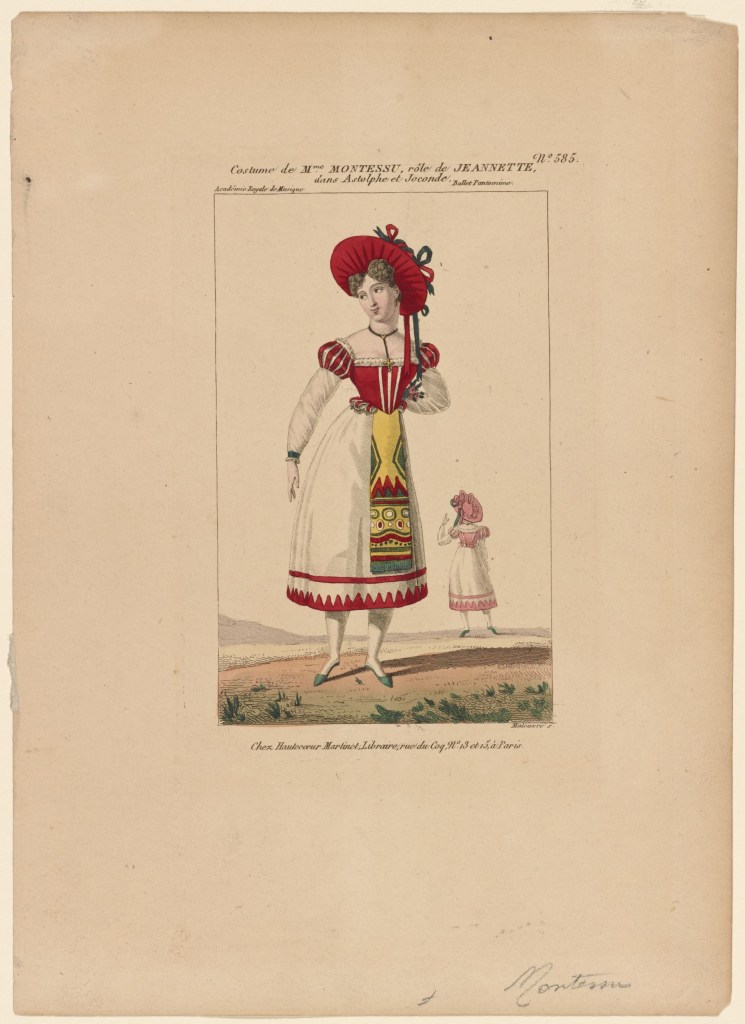
- Jeanette in Aumer’s Astolphe et Joconde, which premiered on 29th January 1827. Author Ivor Guest notes that Montessu was the ‘outstanding success of the [opening] evening’. The 2-Act ballet received 52 performances between 1827-1831.
- In 1827’s Le Sicilien ou L’Amour peintre, an adaptation of Molière’s 1667 play of the same name, Montessu danced a tarantella opposite Ferdinand, a dancer who’d been dancing at the Opera since 1813. This ballet received only six performances, but is remembered for being the ballet that Marie Taglioni made her Opera debut in.
- A true leading role came later in 1827, when Montessu originated the leading role of Thérèse in Aumer’s La Somnambule. Her role included a scene in the third act that involved sleep-walking along the roof of a mill towards the wheel, only stopping at the last moment. The ballet was a success, and stayed in the repertory for over 30 years. Cyril W. Beaumont (1956) quotes a review from the daily newspaper Le Corsaire: ‘Mme. Montessu dances and mimes the part of Thérèse with a perfection that our foremost actresses might envy’.
- Another leading role had previously been danced by Montessu at a different theatres in Paris. In 1825, Montessu and Ferdinand had guested at the Théâtre de la Porte Saint-Martin in a ballet by Jean Dauberval- La fille mal gardée. She returned to the role of Lise three years later, when the ballet entered the Opera repertory. The new production was a success, and Montessu’s dancing and acting were both praised by critics. This was the first production of the ballet to use a score by Ferdinand Herold, the score that remains in modern productions today.
- In La belle au bois dormant (Sleeping Beauty) Montessu danced Nabote, this adaptation’s version of Carabosse. The ballet, by Aumer, premiered on 27th April 1829. The scenario, written by Eugène Scribe, was a very loose adaptation of the traditional fairytale. The ballet stayed in repertoire for around a decade, but was not as successful as La Somnambule, which was produced by the same creative team.
- The team’s next ballet would be more successful, and Montessu would take the title role. Manon Lescaut premiered on the 3rd May 1830, and would be performed 47 times in the next two years. Montessu’s acting was deemed moving, particularly in the final scene.
- Jules Perrot, a dancer who would go on to choreography Pas de Quatre and co-choreograph Giselle, danced in a pas opposite Montessu in 1831 L’Orgie. This ballet, choreographed by Perrot’s Giselle collaborate Jean Corrali, was unsuccessful, and only remained in repertory for about a year.
- On December 19th 1832 she first danced the role of Nathalie in Nathalie, ou La Laitière suisse. Earlier that year Filippo Taglioni had revived his 1821 ballet for his daughter Marie, but Montessu only gained a chance to dance the role in December.
As the Opera progressed in the 1830s, Montessu started to appear less and less in lists of leading roles, during a period when Marie Taglioni, Pauline Leroux, Amélie Legallois and Fanny Elssler were dominating the stage. Montessu did continue to shine in Opera divertissements, however, something she had always shone in.
Perhaps her most notable Opera dance was in Le Rossignol, as on the 23rd June 1830 she danced opposite Jules Perrot, in his Opera debut. One of her last divertissements was in Giacomo Meyerbeer’s Les Huguenots, where she danced opposite Joseph Mazilier.
A US Library of Congress playbill record shows Montessu made two appearances in London in February 1833, at least one of which was at the Theatre Royal, Drury Lane. The wording in the programme record ‘when she will introduce two of her most celebrated dances’ leads me to believe Montessu brought dances from Paris over with her, which were then inserted into one of the pieces. This was very common at the time.
Montessu had become Montessu in 1822, when she married Laurent-François-Alexandre Montessu (c.1795-1861). Around late 1827-early 1828 she took some time off from the company to have a baby, though I could find no more information on this baby. There were many rumours that Pauline had an affair with Emile Lubbert, who was Director of the Opera from 1827-1831, and that Lubbert pushed for her to receive leading roles. Ivor Guest writes that Pauline’s supposed response to finding out she was pregnant (‘If only I knew who was responsible for this’) became a classic line at the Opera.
Little is known about Montessu’s life after leaving the Opera, but it is known that she continued to dance for at least a few more years. She passed away in 1877, and sources give either a death date of the 28th July or the 1st August.
Sources
Beaumont, C.W. (1956). The Complete Book of Ballets. Putnam.
Guest, I. (1966). The Romantic Ballet in Paris. Sir Isaac Pitman and Sons Ltd.
Hibberd, S. (1998). Magnetism, Muteness, Magic: and the Parisian Lyric Stage c.l830. University of Southampton. https://eprints.soton.ac.uk/463573/1/658367.pdf
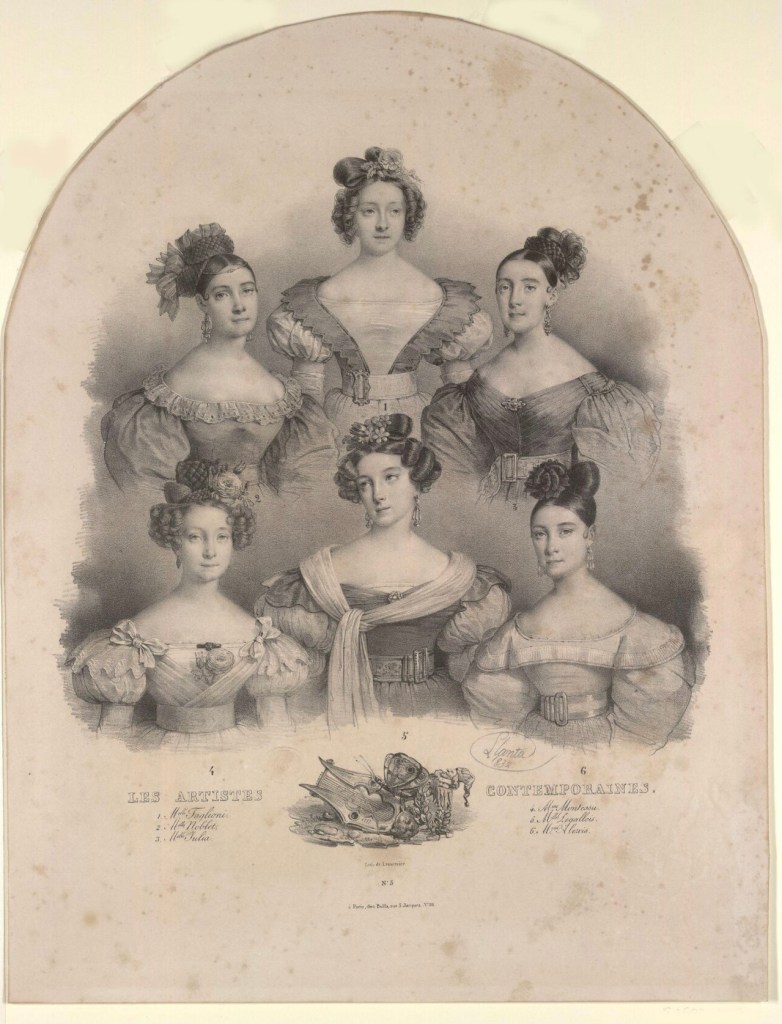
Lemercier. (1832). Les Artistes Contemporaines [Lithograph]. V&A Theatre and Performance Collection (Accession number S.2602-1986). https://collections.vam.ac.uk/item/O102383/les-artistes-contemporaines-print-llanta/
Maleurve. (1827). Costume de Mme. Montessu, rôle de Jeanette dans Astolphe et Joconde [Engraving]. New York Public Library Jerome Robbins Dance Division (Catalog ID b12148513). https://digitalcollections.nypl.org/items/1be59480-bb8d-0132-3a61-58d385a7bbd0
W. Reynolds. (Printer). (1833). Theater playbill for “The Iron Chest,” “The Quaker” and “Masaniello” at Theatre-Royal, Covent-Garden, February 21, 1833 [Programme]. Library of Congress. https://id.loc.gov/resources/works/19204725.html
 Madeleine's Stage
Pingback: Forgotten Ballets: Le Sicilien, ou l’Amour peintre | Theatre Journeys