Photo Drew Tommons.
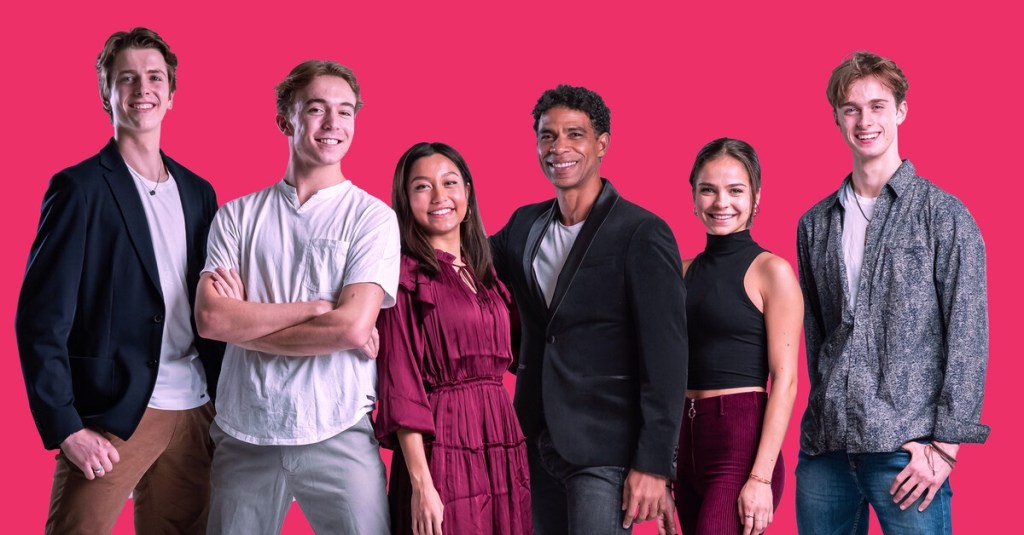
The Birmingham Royal Ballet 2 is currently travelling across the UK on their inaugural tour. Featuring young dancers performing a diverse repertory (as the name of the show implies, selected by BRB Director Carlo Acosta), the tour perfectly showcases the talent of the company. The five dancers of the fledgling company, jack Easton, Maïlène Katoch, Frieda Kaden, Oscar Kempsey-Fagg and Mason King, were joined on this tour by artists and soloists from Birmingham Royal Ballet.
In what I believe is similar to Acosta’s own tours, the show begins backstage. Not actually backstage, but on a stage full of lighting rigs, chairs, flight cases and an upstage central barre. The dancers appear, in rehearsal clothes, and start to prepare. The show continues with this framing, particularly in the first act, the backdrops rising following a piece. I thought this was a brilliant way of doing it; the result was a friendly atmosphere between dancers and audience, and the audience were even happier when the dancers triumphed.
Act I consisted of classical works, while Act II shone the spotlight on modern ballets. The show began with the Pas de Deux from Frederick Ashton’s Rhapsody, danced by Maïlène Katoch and Enrique Bejarano Vidal. Rhapsody, created in 1980 for Mikhail Baryshnikov and Lesley Collier (and staged by Collier and Isabel McMeekan) is a work that I see as blissful, and Katoch and Bejarano Vidal were exactly that. The pair danced in harmony, and they brought the ballet to life. It was a wonderful way to start the programme, and was the favourite piece of the ballet novices that accompanied me.
Following this was the La Sylphide Pas de deux. We tend not to see a large amount of the Danish style in the UK, and it was nice to get a glimpse into the most famous of August Bournonville’s works. Freida Kaden and Jack Easton managed to transcend the problem a lot of ‘gala-programmes’ tend to have: it can be difficult to get into character. They were perfectly believable in their roles, and both had the grace required for the style of dance.
Another pas-de-deux followed, from a ballet probably everyone in rhe audience knew. In the White Swan Pas de deux from Act 2 of Swan Lake Swan Lake, Lucy Waine was an enchanting Odette, and Oscar Kempsey-Fagg a dreamlike Siegfried. They too had strong characterisation, and their partnering work was exquisite. I was expecting to find it a rather vanilla Gala piece, but Waine and Kempsey-Fagg proved me wrong.
More melancholy swans appeared, two for the price of one in fact, in a piece titled Dying Swans. Ava May Llewellyn was Mikhail Fokine’s Dying Swan, while Eric Pinto Cata danced Michel Descombey’s more modern interpretation, with a lot of contortionist-like choreography. My interpretation of the piece was that the swans showed the two sides of death- the traditional swan in her tutu is graceful until the end, while the modern swan’s movements are more writhing. Both Llewellyn and Pinto Cata performed brilliantly, and their phrasing during the first part (danced to a wasteland-like ambience) was outstanding. It was a beautiful interpretation of the Gala standard.
Act I finished with Agrippina Vaganova’s Diana and Actaeon Pas de deux, danced by Beatrice Parma and Enrique Bejarano Vidal. While I had never seen this work live before, I knew it was one of the Russian Grand Pas de deuxs, so was expecting a technical showstopper. And I was very glad to be right. Bejanarano Vidal and Parma were both electric in their leaps and turns, and had very strong technical prowess. Like the other Russian Grand Pas de deuxs (think Le Corsaire), it was a lively way to end the Act.
The Act II opener, Ben Stevenson’s End of Time, is a piece that to me, personally, is magnificently beautiful, and the chance to see it again was part of the reason I booked. Maïlène Katoch and Mason King portray the last two people on Earth, and were mesmerising to watch. The emotion in their dancing was tear-inducing; it was one of those performances you couldn’t take your eyes off. Jeanette Wong and António Novais accompanied on the piano and cello respectively, and added to that mesmerising atmosphere.
A trio of works set in a cafe followed. The first was A Buenos Aires, danced by Olivia Chang Clarke and Enrique Bejarano Vidal. Choreographed by Argentinian Gustavo Mollajoli, the movements are a mix of ballet and tango. It’s tricky to try and merge both of these styles, and Chang Clarke and Bejarano Vidal managed to pull it off in smouldering fashion.
Frieda Kaden danced to Edith Piaf’s Je ne Regrette Rien. I found the choreography to be quite interesting, with a lot of sharp arm movements. I’m not sure I would’ve liked it as much as I did had a dancer who wasn’t completely in control had danced it. Kaden met every movement in time with the music, and danced with such ease. It was so fun to watch her dance. In the end I came away from the piece a little puzzled, but hoping that someday Kaden will get the chance to shine as Swanilda.
Riku Ito danced to another French standard: Jacques Brel’s Les Bourgeois. Like Je ne regrette rien, this piece was choreographed by Ben van Cauwerbergh. Portraying a drunk on a night out, Ito was both comically and technically brilliant, and was a favourite with the audience. There were similar movements in van Cauwerbergh’s pieces, and like Kaden, Ito was confident in the style.
Carlos Acosta’s own Carmen Pas de deux was danced by Maïlène Katoch and jack Easton. Katoch was a seductive Carmen, as a Carmen should be, and Easton was an Escamillo fully under her spell. I wasn’t 100% convinced by the music (taken from Rodion Shchedrin’s Carmen Suite, after Georges Bizet), but I was 100% convinced by the dancers.
Regan Hutsell, sporting an uncomfortable-looking hoop petticoat over a unitard, danced Will Tuckett’s Nisi Dominis. Set to Claudio Monteverdi’s piece of the same name (from his Vespro della Beata Vergine), the piece was hauntingly beautiful. Hutsell triumphed over the hoop petticoat, and was spell-binding.
The final piece was Jorge Garcia’s Majisimo, a programme-finisher so perfect it was given the same honour when Birmingham Royal Ballet last visited Nottingham. Olivia Chang Clarke, Riku Ito, Ava May Llewellyn, Oscar Kempsey-Fagg, Rachele Pizzillo, Mason King, Lucy Waine and Eric Pinto Cata made up the ensemble of eight dancers, and they all looked like they were having the time of their lives. The Spanish-style piece involves a lot of fan-work from the ladies, while the mens’ arm movements are reminiscent of toreadors. The turns in these piece are worth highlighting, they were a spectacular end to the afternoon.
The dancers returned to their upstage barre at the end of the programme, collecting their bags and heading offstage. The audience begin to applaud this, and didn’t stop applauding until the end of six or seven bows.
Carlos Acosta and Artistic Coordinator Kit Holder have developed an ensemble of dancers with a wealth of talent, and proves why ventures like this are so beneficial. The dancers have bright futures ahead of them, and I’m hoping that BRB2 itself does as well.
This performance was reviewed in Nottingham, at the 29th April 2023 Matinee. The tour continues to Peterborough (3rd-4th May), London (13th-14th June) and Wolverhampton (24th June). Find out more here.
 Madeleine's Stage