Many of the names we associate with the early development of British ballet became well-known in the 1920s. Marie Rambert founded her first group, known as the Marie Rambert Dancers, in 1926, and Ninette de Valois formed the Vic-Wells Ballet in 1931. However, there was still strongholds of ballet in Britain before this period; Rambert and de Valois happened to come along after a lull. In the late 19th-century and early 20th-century British ballet was centred at two London theatres: the Alhambra and the Empire.
The first proper corps de ballet at the Alhambra was engaged in 1863, three years after the theatre’s opening. They was informally dissolved in 1912 (so informally an official date doesn’t seem to have been noted), but ballet continued on the bill up until the theatre’s demolishment in 1936. The Ballet Russes staged their production of The Sleeping Princess there in 1921, and Frederick Ashton choreographed dances for the Alhambra’s 1932 production of the operetta A Kiss in Spring. Today, I’d like to focus on the 1870s to the 1910s, when the Alhambra created many ballets using their own company and creative team.
At this time it was less common to keep ballets around in a repertory to be revived every few years. A lot of works were kept around for a certain amount of time, then discarded, particularly if they capitalised on a popular style or event. That’s not to say works couldn’t be revived, but it was the exception, not the norm. The general trend was for a ballet to stay in the repertory for between 10-30 weeks. The ballets on this list surpassed the 30 week average.
Note: The study of how long ballets stayed in the repertory was done by Ivor Guest.
The Swans (1884)
Premiere: 1st December 1884
Weeks in the repertory: 49
If I were to give you one guess at what this ballet was inspired by, I’d be confident that the vast majority of people reading this would guess right. The Alhambra’s 1884 production of The Swans was indeed based on Swan Lake, and who better to choreograph it than the person responsible for two of the first revivals.
Joseph Hansen (1842-1907) had worked at the Théâtre de la Monnaie in Brussels, Belgium. He began his career as a dancer, moving then to the post of régisseur, and finally became Maître de ballet of La Monnaie in the 1870s. In 1879 he took up a post at the Bolshoi in Moscow, staying until 1882. It was there that he produced Swan Lake. His stagings, in 1880 and 1882, came just a few years after the 1877 premiere, which was not deemed particularly successful. Hansen’s revivals did not elevate the opinion of the ballet much, and his second revival only had 4 performances before dropping out the Moscow repertoire.
When Hansen took up a job at the Alhambra in 1884, the Alhambra was technically only a year on. In 1882 the original Alhambra had burned down, and had to be rebuilt. The ‘new’ Alhambra opened on the 3rd December 1883. Ballet thrived at the new Alhambra – while ballet had always had a presence at the theatre, in was in the 1880s that it would become the main event. Two ballets were given each night, the first concluding the first half of the bill, and the second ending the night’s performance.
As you can gather from this, The Swans did not follow the entire storyline of Swan Lake, only the Second Act, which it followed reasonably well. A hunting party comes across a corps of Swans, and the leader of the huntsmen becomes enamoured with the Swan Queen. In a deviation that provided a more concrete ending, Hansen added rusalkas to the plot. The rusalkas (figures taken from Slavic folklore) lure the huntsmen into the lake, leading them to their deaths. The leader of the huntsmen is reunited with the Swan Queen.
Tchaikovsky’s iconic music was not carried over from Hansen’s Russian revivals. A new score was composed by Georges Jacobi, the Alhambra’s musical director from 1872-1898. Costumes were done by C. Wilhelm, a professional name for William John Charles Pitcher, who had first costumed for the Alhambra in 1878. He continued to costume British ballet into the 1910s. Scenery was designed by Mr C. Brew.
This was the first ballet Hansen choreographed for the Alhambra, and as stated, managed a 49 week run. When a ballet ran for that long changes would be made. New dances may be added for new cast members, and new music might be created. The most notable change for The Swans was the dancer in the role of the leader of the huntsmen.
The Alhambra’s corps de ballet was entirely female, and these dancers were expected to perform male roles en travesti. Emma Palladino, a celebrated dance who was prima ballerina at the Alhambra from 1881-1888, originated the role of the Swan Queen. The leader of the huntsmen, sometimes called Roland, was created for a Miss Matthews. A Miss Sampietro danced an unidentified role. Lillie Lee, a danced who had been active since the early 1870s, was engaged in the role of the Queen of the Rusalkas in Summer 1885.
Later in the Summer a male dancer was hired to dance the role of the hero. Giorgio Sarraco danced opposite Emma Bessone, another celebrated dancer. Bessone took the role of the Swan Queen, and would dance with the Alhambra from 1885-1890. In 1887 she would guest in Russia, where Marius Petipa revived Giselle for her, and Lev Ivanov created the leading role in La Tulipe de Haarlem for her. Sarraco would dance at the Alhambra again in 1889 alongside his sister Maria.
Hansen’s second ballet at the Alhambra, Melusine, would see a similarly successful 47 week run. The Swans was also produced at the Théâtre de la Bourse in Hansen’s home city of Brussels, and in Paris (though not at the Ópera). Though it would take decades for a full production of Swan Lake to be performed in Britain, The Swans‘ success foreshadowed the monumental success of its inspiration.
Our Army and Navy (1889)
Premiere: 1st April 1889
Weeks in the repertory: 51
Hansen left the Alhambra in 1887 to take up the post of maître de ballet at the Paris Opera, a role he’d continue in until 1907. His successor, Eugenio Casati, produced his first ballet in December 1887. Luckily for him, the Alhambra was still a half-coloured picture, and he was able to influence a turn towards more dramatic ballets during his tenure. Unfortunately for him, management wanted a patriotic ballet. Even more unfortunately for him, they wanted a reworking of a ballet first created by Hansen.
The Alhambra’s corps was known for being able to dance in strict formations, similar to an army battalion. Hansen had capitalised on this with his 1885 ballet Le Bivouac. Contemporary reviews of Le Bivouac note that battalions across the UK were represented by folk dances. This ballet was immensely popular, something that management noted. Perhaps begrudgingly, Casati took to reworking Le Bivouac into Our Army and Navy.
The score for Our Army and Navy, again by Jacobi, was essentially his score for Le Bivouac but with extra music added. The dances were rearranged by Casati. Taking place in Portsmouth, the ballet featured representatives of British and foreign armies, with the foreign armies including France, Germany, Spain, Belgium, Austria, Italy, Egypt, Russia, Turkey and America. Each country entered to folk music or the countries’ national anthem.
There was no plot to the ballet, but there were principal characters. The General Officer was danced by a Madame Roffey. There are a whole series of Roffeys in ballet, going back to the 1790s, and this one is hard to pin down a forename for. The two midshipmen were danced by Minnie Thurgate and a Miss Phillips.
Reviews were mostly favourable towards Our Army and Navy, which was a triumph for Casati considering Le Bivouac was also received well. The Penny Illustrated (6th April 1889) called it a ‘banquet of rich and dazzling colours’, and predicted it would run through the Summer (and they were correct). On the other hand, the Weekly Dispatch (7th April 1889) called it a ‘misguided production’ and a work unfit to be performed in ‘the home of ballet’. They did however, note that Casati was not responsible for the production, suggesting it was easy to presume that this was not his decision.
Le Bivouac ran for 47 weeks, meaning Our Army and Navy beat its run. Not bad for a reworking.
Femina (1910)
Premiere: 30th May 1910
Weeks in the repertory: 51
Another ballet lasted 51 weeks in the repertory, but this time it was the choreographer’s final ballet at the Alhambra, not of their first. Alfredo Curti had come to the Alhambra in 1904, during the last decade of prosperity. His final work was Femina, which was also the final Alhambra company ballet to run for more than 30 weeks.
Ivor Guest describes the ‘underlying theme’ of Femina as the ‘power of vanity over women’. The ballet began in the Garden of Eden, with the central character being the titular Femina (a working title for the ballet was Flowers and Leaves). Femina’s story is followed through the Stone Age and into Ancient Assyria, then to Spain, and ending in the Kingdom of Vanity (a chance for the designers to create spectacle).

By this point Jacobi had left the Alhambra, and the music for Femina was composer by his successor, George W. Byng. Music for the Spanish scene was provided Señor Valverde. The Weekly Dispatch (29th May 1910) describes Señor Valverde as ‘the popular Spanish composer’, which leads me to Quinito Valverde (full name Joaquín “Quinito” Valverde Sanjuán).
The principal dancer was La Belle Leonora, who had come to the Alhambra from Paris in 1908. Curti had taken a fancy to her, and created many leading roles for her. In the role of the Spirit of Vanity was Britta Petersen, a Danish dancer who had been engaged by the Alhambra for two seasons. Lola La Flamenca, a popular Spanish dancer who had performed in Florenz Ziegfeld’s 1908 musical Miss Innocence, performed dances in the Spanish scene.
By this point the Alhambra had become more accustomed to male dancers dancing male roles. An original cast list features Mr Charles Reymond as the High Priest, Mr Tom Coventry as the Keeper of Posada, and Mr R. Vallis as the Old Chief. The former two had been employed by the Alhambra since the late 1890s. Similarly to Lola La Flamenca, Señor Faico, took the role of a Spanish Espada.
A troupe of Russian dancers, known as the Ri-Tchave Troupe, appeared in the Stone Age scene, providing what one reviewer in The Era (4th June 1910) described as ‘immense vitality’. This Troupe was no doubt engaged following the success of the Ballet Russes, who had debuted the previous year.
Critics predicted success for Femina, and were correct with their predictions. However, this was to be the last smash hit for the Alhambra, and is the latest ballet on this list. Half a dozen ballets would be created between 1910 and 1912, including The Dance Dream, another attempt to capitalise on the new popularity of Russian dancers, but none of these ballets would see as much success as Femina did.
L’Amour (1906)
Premiere: 11th June 1906
Weeks in the repertory: 53
Curti’s era at the Alhambra brought about multiple long running ballets, not just Femina. 1906’s L’Amour had an exotic theme that was popular with audiences at the time. Set in Assyria, the ballet centred around King Darius trying to find a suitor for his daughter Mylitta. A competition is held, and Prince Nashur wins it (with a little help from Mylitta herself). His next challenge is to survive a night in a temple while not succumbing to the charms of the sirens who inhabit it. Mylitta appears as one of the sirens, and is it only then that Nashur succumbs. He is taken by the guards, by Mylitta reveals herself and frees him.
The scenario was written Charles Wilson and Mrs Thomas Hay Ritchie (real name Fannette Ritchie, née Ronalds). Music was not done by George W. Byng, but instead by Francis Thomé, a French pianist who had composed for the stage before. The scenery was done by E.H. Ryan, and costumes were designed by Atillio Comelli, artist-in-chief at the Alhambra and house designer at the Royal Opera House. The scenery was described as luxuriously grand, befitting the setting.
Nashur was danced by Curti himself, and was noted to be effective in the temptation scene, which from reviews can be gathered to have been a bit longer than it needed to be (you can imagine why). Italian dancer Maria Bordin, who was known in London for dancing in the ballet Excelsior, danced Mylitta. In other important parts were Signora Frieilli, Signora Adelina Rossi, Miss Edith Slack and Signorina Enrica Varasi.
Reviews of the ballet noted that the design for the ballet lived up to the Alhambra tradition of a grand spectacle, and highlighted the compelling performance of the dancers. The Sporting Times (16th June 1906) and Truth (20th June 1906) both note that Nashur succumbed to Mylitta when she appears with ‘veils’. 7 months earlier, Richard Strauss’ opera Salome premiered, featuring Salome’s Dance of the Seven Veils. The Sporting Times review notes that Mylitta gets down to her last veil, and that may well indicate why the ballet was so popular.
The Alhambra thrived on ballets in this fashion, and it was what had made them popular in the first place. However, an article in The Bystander (20th June 1906) laments the fact that ballet production is so overblown. The writer makes their case, saying that the ‘most perfect form of dance’ would be a dancer with nothing more than a pair of pointe shoes and some nice arm work. Over on the other end of the scale, the writer notes that dancers now have to juggle a multitude of props.
L’Amour ran for 53 weeks, becoming the last Alhambra ballet to surpass a 50-week run.
My Lady Nicotine (1905)
Premiere: 27th February 1905
Weeks in the repertory: 55
The Alhambra often found inspiration in the topical subjects of the day, and this inspiration for this ballet came from the rising number of women who were smoking (there is no relation to the J.M. Barrie book of the sake name). The health detriments of smoking were not recognised yet, and women smoking was seen as a huge step forward, as it had previously been a man’s habit.
My Lady Nicotine was the first new Alhambra ballet in half a year, as the two ballets in the programme before it were highly successful (in fact, one of them was the longest-running Alhambra ballet). Instead of the ballet being devised by the choreographer, the idea for My Lady Nicotine came from the scenarist Charles Wilson. The dances were arranged by Lucia Cormani, who had been at the Alhambra since Hansen’s term in the 1880s, first as a dancer and then as principal of the theatre’s attached ballet school. She choreographed most of her ballets in the 1903-1905 period, between the eras of Curti and his predecessor. It seems they were trying her out as a resident choreographer, but this doesn’t seem to have lasted long, as My Lady Nicotine was her last Alhambra ballet.
Music for the ballet was done by George W. Byng, and was praised for being bright, and for matching with Cormani’s choreography. The scenery was designed by E.H. Ryan and Philip Howden, and Atillio Comelli once again handled costume design. The costume making was by Charles Alias, who’s firm made costumes for a majority of the Alhambra ballets of the era.
The ballet was presented in 5 scenes, all to do with smoking. The first was on a Virginian plantation, the second in a Turkish Harem, the third in Holland and the fourth in a tobacco grove. The last, and the Alhambra-level spectacle, was the home of ‘My Lady Nicotine’. There seems to have been little of an overarching plot.
A review in The Era (4th March 1905) notes a lot of the participating cast. Madame Cormani herself danced in the ballet, alongside the aforementioned Miss Edith Slack. Other parts were danced by Rosie Deane, Julie Reeves, Nellie Hill, Belle Davis, Susie Raymond, B. Fletcher, Queenie Wood, L. Lauri, D. Lyons, Reba Kaufman, Ines Kaufman, L. Bryant, Norah Saunders, May Earle, and a dancer by the name of La Sylphe. The only male they mention is Giovanni Rosi.
Luckily for us, a series of photographs of My Lady Nicotine have survived, and are in the collection of the V&A Museum. The photos were taken by Campbell-Gray, and are in the Alhambra Moul collection, named for the Director of the Alhambra at the time.

My Lady Nicotine lasted 55 weeks on the programme. Pictures of women smoking cigarettes lined the Alhambra’s entrance and the ballet became highly popular with the Edwardian audience. Three of the four ballets left to explore are from 1904 or 1905, but are fortunately not about tobacco.
All the Year Round (1904)
Premiere: 21st January 1904
Weeks in the repertory: 56
All the Year Round was one of the long-running ballets that preceded My Lady Nicotine, and was another ballet with a scenario by Charles Wilson and choreographed by Lucia Cormani. Fred Farren and Giovanni Rosi co-choreographed with Cormani, and James M. Glover composed. Once again costumes were designed by Atillio Comelli and made by Charles Alias. Scenery was handled by the rather large team of E.H. Ryan, T.E. Ryan, W.B. Spong. Bruce Smith and Philip Howden.
The ballet was in seven scenes, taking the audiences through the year with popular dances for each month. All months were featured in the ballet (with some months being squashed into the same scenes), brut reviews tended to highlight the February, April, May, June and December dances. The ballet had a runtime of about 55 minutes, commencing at 9:45 on the Alhambra bill.
Of these, the May scene (by Cormani) was much appreciated, and contemporary costume lists by Alias (in the Alhambra Moul collection) highlight how many costumes were needed for the scene: 8 swallows, 8 Pink May Boys, 8 White May Girls, 8 Laburnum, 8 May Girls and a May Queen. To give an idea of cost, letters in the collection show that each costume cost somewhere between 6 and 9 pounds, and that Alias was hoping they’d be closer to 6.
The Times‘ review of the scene was used in advertising for the ballet following its premiere, and reads ‘The Ballet of the Swallows and Flowers in month of May is one of the most beautiful and graceful scenes that one could hope to see in London’.

Similarly to My Lady Nicotine, photographs survive of the ballet, taken by the London Stereoscopic Company. They show the usual Alhambra luxury, and document the majority of the scenes.
The production was so grand, and the narrative so lacking, that many of the reviews focus solely on the staging and costumes, with hardly a mention of the dancers involved. There’s more mention of the scenery being fireproof than there is of the dancers. The day after the ballet premiered the Lord Chamberlain, Lord Clarendon, and the Chief Officer of the Fire Brigade, Captain Hamilton, visited the theatre so Alfred Moul could show off the fact that his stage was not going up in flames anytime soon (which, as things go, isn’t the worst possible thing to be a show off about).
All the Year Round was a step into the modern-era for the Alhambra, introducing dances like the cakewalk to the Alhambra stage. The 56 week run was highly respectable, but there were some reviewers who noted that more ‘serious’ theatregoers were left hoping for a return to the narrative ballets.
Zanetta (1890)
Premiere: 24th March 1890
Weeks in the repertory: 60
We go back to Eugenio Casati’s reign at the Alhambra for the next ballet, a melodrama set in the Alps. Strictly speaking this ballet isn’t a Casati original; a ballet titled The Alpine Brigands had been performed in the Alhambra’s opera production La Fille du Tambour Major in 1880. This ballet had been choreographed by Aime Betrand, Joseph Hansen’s predecessor.
Zanetta was a short one-scene ballet, with music by Jacobi, scenery by T.E. Ryan and costume design by Lucien Besche. As was the custom, Alias made the costumes. The plot of the ballet was minimal, but centred on a gang who ambush a village. Zanetta and her brother Bertrand are members of the gang, and they make merry in the village before a company of soldiers return to drive them away.
Obviously the appeal of this ballet was not the plot, and reviews show that the Alhambra’s finest were featured in the ballet. Mademoiselle Vergé danced Zanetta, while Madame Roffey was Zanetta’s brother Bertrand. Robin, a traveller set upon by the gang, was danced by Maria Saracco, and Mademoiselle Rosa danced Robin’s servant Jean. Minnie Thurgate and Miss Phillips also had starring roles.
The ballet’s run of 60 weeks was unprecedented, but the ballet wasn’t always presented in its full length. At certain times a shortened version was shown. When first premiered the ballet was danced at the end of the evening, beginning at 10:50. A short article in The Morning Post on 24th September 1980 notes that from Monday 29th Zanetta would be performed at 8:30, with the newer ballet Salandra would take the late-evening slot.
A May 1891 review in The Era (16th May) compliments the new dancers in the ballet, which had undergone cast changes. Mademoiselle Zimmerman, Miss Hoby, Julia Seale and Miss Russell all had featured parts. The ballet managed to hang on until June, but then was replaced in the repertory.
Parisiana (1905)
Premiere: 11th December 1905
Premiere, Second Edition: 19th March 1906
Weeks in the repertory: 61
Parisiana was another ballet devised by Charles Wilson. Similarly to All The Year Round, the ballet was a series of scenes with no overarching plot. The scenes took the audience through Parisian life from 1790 to the modern day, which allowed Curti, the choreographer, to utilise his skills with French traditional dances.
Another thing the ballet shared with All The Year Round was its composer, James M. Glover, although George W. Byng conducted the premiere. Scenery was done by E.H. Ryan, Phillip Howden and A. Menessier.
The ballet happened to premiere at a difficult time for London; the fog was so bad that a little of it had made it inside the theatre. The Sporting Times reviewer (16th December) was a latecomer at the performance, and described it as such: ‘the early comers looked at the later ones much as the survivors of the Light Brigade looked at the last of their comrades straggling back after the great charge’. Luckily for the performers, the audience was mostly full.
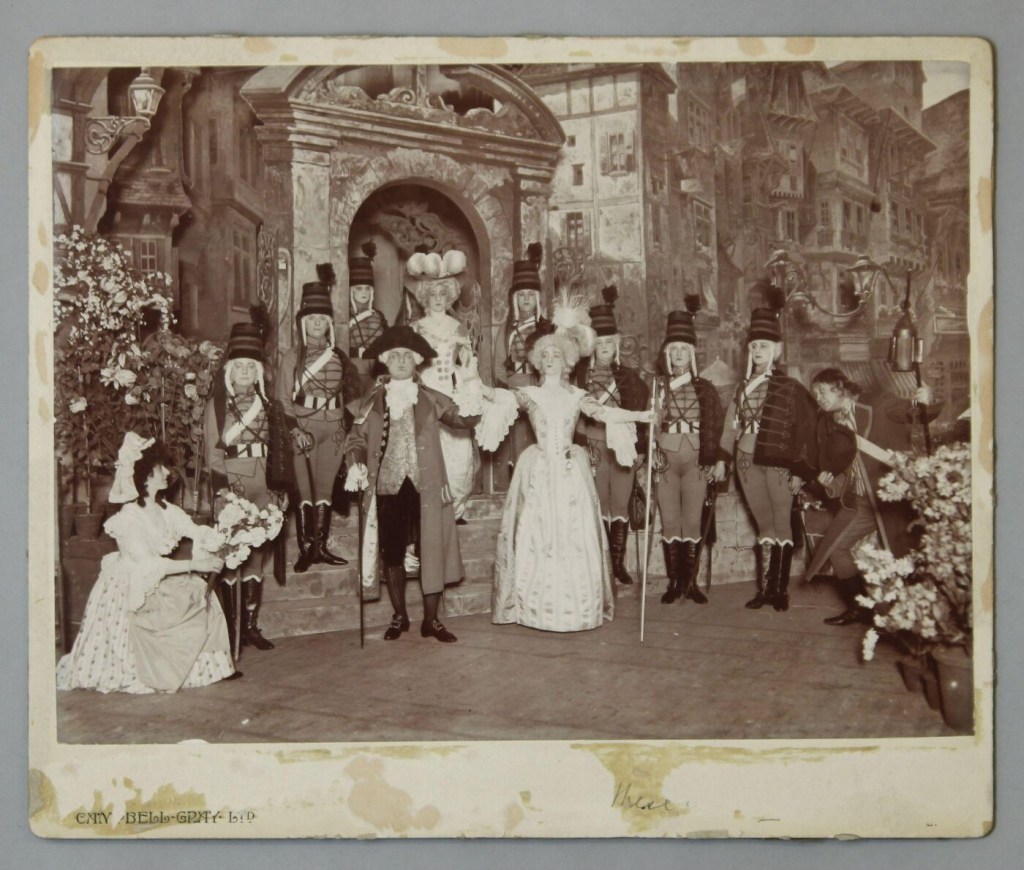
One of the appeals of the ballet was the appearance of Miss Jane May. In 1891 May had appeared in L’enfant prodigue, a mimed play by Michél Carré fils set to music by André Wormser. The production ran at the Prince of Wales Theatre following a run in France, and became a surprise success. May’s performance was particularly acclaimed, and she appeared in a mime role in Parisiana to similar acclaim.
A report on the ballet in The Sportsman (1st December) details some of the artists who would appear in Parisiana: Edith Slack, Rosie Dean, Dina Cormani, Miss A. Mortimer, Miss L. Bryant, Nellie Hill, Ida Baily, Julia Reeve, La Sylphe, Giovanni Rosi, Amadeo Santini, Henri Frielli, Signor G. Almonsi, Signor F. Almonsi, Signor Artelli and Tom Coventry. Maria La Bella also danced in the ballet.
The second edition of Parisiana was produced in March 1906, and inserted a new scene into the ballet, in which La Sylphe had the main role. The new scene was said to be set in the present, and was a way to accommodate for the fact that Jane May’s engagement at the Alhambra had ended. The following week Parisiana made up part of a benefit matinee at the Alhambra. The Courrières mine disaster in France had killed 1,099 miners, and the Alhambra benefit raised funds for their families and others who were affected.
Parisiana stayed in the repertory until February 1907, finishing its run in the middle of the month. It was replaced by Curti’s ballet The Queen of Spades, which used a cinematograph to project a film on a lowered screen, perhaps for the first time in a ballet.
The Entente Cordiale (1904)
Premiere: 29th August 1904
Weeks in the repertory: 67
The Entente Cordiale was made up of three declarations negotiated by Britain and France. These documents were signed on 8th April 1904. While not a formal alliance, the agreements strengthened relations between the two countries. And also inspired the longest running ballet at the Alhambra.
Curti arranged the dances for the ballet, his first work for the Alhambra. Ivor Guest credits the scenario to Malcolm Watson, though contemporary newspaper reviews point to Charles Wilson. Landon Ronald, a composer-conductor who was rising to prominence at the time, composed the music. The trio of E.H. Ryan, Philip Howdon and A. Menessier produced the scenery.
The ballet was made up of a prologue and two scenes. The prologue, set in the ‘Grove of Concordia’, featured dancers representing the 5 Great Powers (probably Britain, France, Germany, Austria and Russia), along with a dancer representing Peace. They are interrupted by the Demon of War. In the first scene, the ‘Temple of Peace’, Germany, Austria-Hungary and Italy form the Triple Alliance, while France and Britain form the Entente Cordiale. The ballet finishes with a look to the future in ‘The Apotheosis of Peace’, in which a ‘Grand Entente Cordiale’ has formed, made up of all the countries of the world.

Giovanni Rosi danced the Demon of War in the first scene, and Edith Slack and Josephine Casaboni were representatives of Britain and France (though which way round they were I’m not sure of). Marjorie Skelley also danced a principal role.
The ballet d’occasion was met with hearty applause at its premiere, and continued to be popular. The Referee (4th September) notes that on the 6th September a group of French delegates were to watch the ballet, and The Gloucestershire Echo (7th September) details that the German ambassador was also in attendance.
Entente Cordiale was still in the repertory by the time of Parisiana’s premiere in December 1905, being performed alongside My Lady Nicotine. Rather amazingly, the next references of the ballet is a transfer. The ballet was performed as part of the Christmas pantomime at the Shakespeare Theatre in Clapham, a district that was at the time a commuter suburb of London. The newspaper reviews do not indicate whether Alhambra dancers performed, but I think it unlikely.
They do however note that Espinosa was responsible for the production. There were a few Espinosas associated with the Alhambra, but this one was Edouard Espinosa, who was working at the Alhambra, the Empire and the Royal Opera House at the time. Edouard was the son of Léon, a celebrated dancer who had produced The Sleeping Beauty for the Alhambra in 1890. Edouard’s sister Judith also danced at the Alhambra. Edouard’s greatest legacy was being a co-founder of the Royal Academy of Dance.
It seems that Espinosa re-choregraphed the ballet, which was part of the pantomime The Forty Thieves. This production ran into January 1906, and was probably the ending point for the ballet.
Conclusion
The Alhambra and the Empire were the main two ballet theatres in London during the late 19th-early 20th century, but they were not the only ones. Ballet thrived in London, and had done for many years. Records exist of British ballet dancers in the 1790s, and the famed Pas de Quatre premiered at Her Majesty’s Theatre.
These two theatres, however, provided large stepping stones for ballet in the UK. I have mentioned Edouard Espinosa, but Adeline Genée, another founder of the Royal Academy of Dancing, had been the prima ballerina of the Empire. The dancers and staff who worked at these theatres introduced generations of audiences to the ballet, but I feel their contribution has been rather forgotten.
Hopefully at least one of the ballets on this list was new to you, and I also hope that this topic has been interesting.
Secondary Sources
Beaumont, C.W. (1956). The complete book of ballets. Pitman.
Guest, Ivor. (1992). Ballet in Leicester Square. Dance Books.
Guest, Ivor. (2004). The Paris Opera Ballet. Dance Books.
Pritchard, J. (2001). Collaborative Creations for the Alhambra and the Empire. In Dance Chronicle, 24(1), pp. 58-82. https://www.jstor.org/stable/1568052
Pritchard, J. (2014). Archives of the Dance (24): The Alhambra Moul Collection at the Victoria and Albert Museum. In Dance Research: The Journal of the Society for Dance Research, 32(2), pp. 233-257. https://www.jstor.org/stable/43281369
 Madeleine's Stage