In the last months of the Second World War, the Council for the Encouragement of Music and Arts were discussing what to do with a London theatre that was currently in use as a dance hall. Led partially by John Maynard Keynes, negotiations took place for music publisher Boosey & Hawkes to become the theatre’s new tenants, replacing Mecca Enterprises. This takeover, if it went through, would mean the end of ballroom dancing in the theatre, and a possible installation of an opera company and a ballet company at the venue.
This theatre was the Royal Opera House, and you can figure out from there that the deal, in fact, did go through. Keynes and David Webster, administrator of the Covent Garden Preliminary Committee and later General Administrator of the theatre, began to consider the possibility of moving Ninette de Valois’ Sadler’s Wells Ballet to Covent Garden. Throughout the war the company had given seasons in theatres across London, and toured England, while their London home was being used as a shelter. In early 1945 they travelled to Brussels, then Paris, performing for soldiers as part of the Entertainments National Service Association. Two short London seasons followed, then another ENSA tour, this time to Germany.
While the company toured, director Ninette de Valois was working with both Covent Garden and Sadler’s Wells to negotiate a transfer of the dancers and their staff. By the time the Allies accepted Germany’s unconditional surrender, on the 8th May 1945, a re-opening date for February 1946 had been set. The plan was to open with a bill performed by the Sadler’s Wells Ballet, who despite the move would retain their name, and a company from Paris. The planning for this venture would be too difficult, and in the end it was decided that the production that would reopen the Royal Opera House would be The Sleeping Princess.
Background
This would not be the first production of the ballet by the company. The Wedding Pas de deux, from the final Act, had been in the repertory simce 1935. A full production of The Sleeping Princess was produced in 1939 by Nicholas Sergeyev, a répétiteur from the former Imperial Ballet in Saint Petersburg. This production premiered in February 1939 with Margot Fonteyn and Robert Helpmann leading the company.
The new Sleeping Beauty, as it was now named, was also to be supervised by Sergeyev. The costumes and sets were designed by Oliver Messel, and despite having to adhere to post-war rationing, he would produce elaborate backdrops and tutus for the ballet. He was assisted in his endeavours by Fonteyn’s Mother Hilda Hookham, who was known to the company as the ‘Black Queen’.
It was David Webster who announced the changes to the Sadler’s Wells Ballet, in, of all places, a department store. Webster was a Manager of Lewis’s, a local British department store chain, which had a store in Manchester. He gathered the company in September 1945 while they were in the city performing at the Opera House, and from there the company was set alight with ideas.
Another ENSA tour of Germany followed, which takes us up to December 1945. The company arrived back in England just in time for Christmas, and after having time off to celebrate the company began rehearsing in January 1946. Rehearsals took place at the Royal Opera House, but also at Holborn Hall, Sadler’s Wells, and the West Street Studio.
Multiple casts were rehearsed for the ballet, which was to be given a first run of a month. A new programme would only premiere on the 18th March, and before that date Sleeping Beauty was performed nightly. Margot Fonteyn and Robert Helpmann led the first cast as Aurora and her Prince, with Beryl Grey as the Lilac Fairy, while Pamela May and David Paltenghi led the second cast.

Premiere
In the week leading up to the premiere, rehearsals escalated. Designer Oliver Messel supervised dress rehearsals, while Musical Director Constant Lambert oversaw the large orchestra. While most of the choreography was after Marius Petipa, Ninette de Valois and Frederick Ashton had provided original dancea for the production. Ashton’s notable contributions included the Garland Dance in Act I and Florestan and his Two Sisters in Act III.
The big dance floor which had covered the stalls was removed and ageing seats, retrieved from the basement, reinstated in their rightful positions. Carpenters repaired them, and workmen were still securing them to the floor right up to the last minute before the opening night…
Beryl Grey. In For the love of dance, p.50
An article in the 4am edition of the News Chronicle on Wednesday 20th details two girls who had began queueing at midnight outside the Royal Opera House. They were in-line for the 20 standing places that would be sold from the box office. For most of the audience, this would not be necessary, as dignitaries and politicians filled the auditorium. The Guests of Honour were King George and Queen Elizabeth, who arrived with their daughters Princess Elizabeth and Princess Margaret, and the King’s Mother Mary of Teck.

On the 20th the company gathered for class with Harold Turner, and then were given final notes by de Valois. The 20th was also dancer Gillian Lynne’s 20th birthday, and the company sang their well-wishes to her amongst the final preparations.
When the curtain went up the company faced an audience of men and women in evening dress, with many men proudly wearing their wartime medals. The return of British pomp and glamour had arrived, just months after the war had ended.
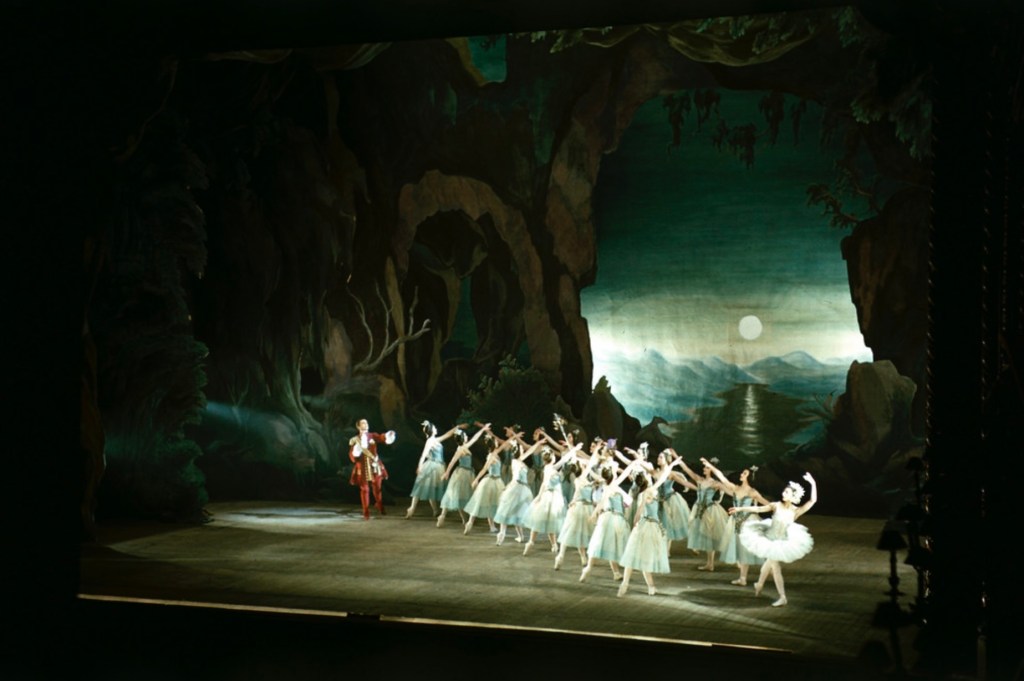
The performance itself proved that bringing the company to Covent Garden was the correct choice. Of course there were things to be worked – most of the dancers were used to performing on much smaller stages. A recent addition to the company was Violetta Elvin, née Prokhorova, who had arrived in the UK from the Soviet Union. Other members of the company noted it was her who was most used to the vast stage they were now working on.
Reviews of the evening from critics were positive, noting that the company had not only improved their level of skill over the wartime years, but also helped make ballet popular. It was pointed out that ballet on the Royal Opera House stage had been reserved for Gala evenings or Ballets Russes’ companies, so to have an English company presenting their works was an exciting occasion.
Fonteyn’s performance as Aurora was praised, as was Beryl Grey as the Lilac Fairy. Pamela May debuted as Aurora on the 21st, and was similarly praised for her dancing and elegance. The orchestra under Constant Lambert were highlighted as another triumph, as was the sumptuous designs of Oliver Messel. For many reviewers it felt like the start of a new post-war era of British theatre.
The company had come out of the war with the strongest claim to being the country’s national ballet company, and thrown around in the reviews is speculation on whether the company would succeed in their new home. It’s obviously clear now that they did, but the hope is evident in many of the reviews.
…the Beauty indeed had re-awakened the great theatre and recreated something truly beautiful and uplifting. To the astonishment of many sceptics, the Company proved that they could follow in the Russian dancers’ footsteps, receiving a remarkably good press.
Beryl Grey. In For the Love of Dance, p.51
In April 1946 a new ballet premiered, followed by another, and then another. The company continued to cement their place at the forefront of British Ballet, and in 1956 the Sadler’s Wells Ballet became the Royal Ballet. While the 1946 production wasn’t the first Sleeping Beauty staged by the company, it was the most important.
Sources
Bland, A. (1981). The Royal Ballet, the first fifty years. Doubleday.
Fonteyn, M. (1976). Margot Fonteyn: autobiography. Alfred A. Knopf.
Grey, B. (2017). For the love of dance. Oberon.
Lynne, G. (2011). A dancer in wartime: one girl’s journey from the Blitz to Sadler’s Wells. Chatto & Windus.
Vaughan, D. (1999). Frederick Ashton and his ballets (2nd ed.). Dance Books.
 Madeleine's Stage