In the late 1920s Ninette de Valois founded a School of Dancing in London. Her ultimate aim was to form a British Ballet company. Around the same time, de Valois was hired by Lilian Baylis, owner of the Old-Vic, to train her drama students in movement. Baylis also owned the Sadler’s Wells Theatre, and despite financial trouble, was rebuilding it. In 1931, when the theatre reopened, a small ballet company was formed at the theatre, to be known as the Vic-Wells Ballet.
Beatrice Appleyard was one of the first students at de Valois’ school, and one of the first members of the Vic-Wells Ballet, which would eventually evolve into the Royal Ballet. The dancers who appeared with the company in those first few years are often overlooked, so I’d like to tell you of one of them now.
From Roland Gardens to Sadler’s Wells
Beatrice Appleyard was born in 1913 to Charles and Mary Appleyard. In the 1921 census Charles is listed as a dentist, while Mary’s occupation was ‘Home Duties’. Beatrice had an older sister, Mary Margaret, who was born in 1912. Dorothy Hilda (born 1915) and David Charles (born 1917) are also listed on the 1921 census.

Beatrice was born in Battersea, London, but the family relocated to Maidenhead in Kent when she was young. They were still living there in 1921, when their address was listed as being on Courthouse Road. She received her first dance lessons in Maidenhead before joining de Valois’ school around 1927. Each Winter the students would dance in a short ballet preceding a show at the Old Vic, and there were other opportunities for them to dance as well. One such opportunity came when de Valois staged her own evenings of dance. At one evening in 1930, Beatrice performed in de Valois’ So Fair a Satrap (Lao and Danae).
When the Vic-Wells Ballet was formed in January 1931, there were six dancers permanently employed: Beatrice Appleyard, Freda Bamford, Sheila McCarthy, Ursula Moreton, Nadia Newhouse and Joy Newton. They made their first appearance on the 20th January, dancing in the opera Carmen. The school established by de Valois had also now come under the umbrella of the Vic-Wells theatres.
The ‘first performance’ of the Vic-Wells Ballet could be said to have happened on the 5th May 1931 at the Old Vic, when the dancers had the whole evening to themselves. The troupe was augmented by additional female dancers. On the male side dancers Anton Dolin, Stanley Judson and Ivor Beddos, and actor Leslie French appeared as guest stars. The programme consisted of shorts works, the majority being choreographed by de Valois, who also danced in the works. The Stage (7th May 1931) described the company as showing ‘admirable proficiency in execution as well as charm and grace in movement’.
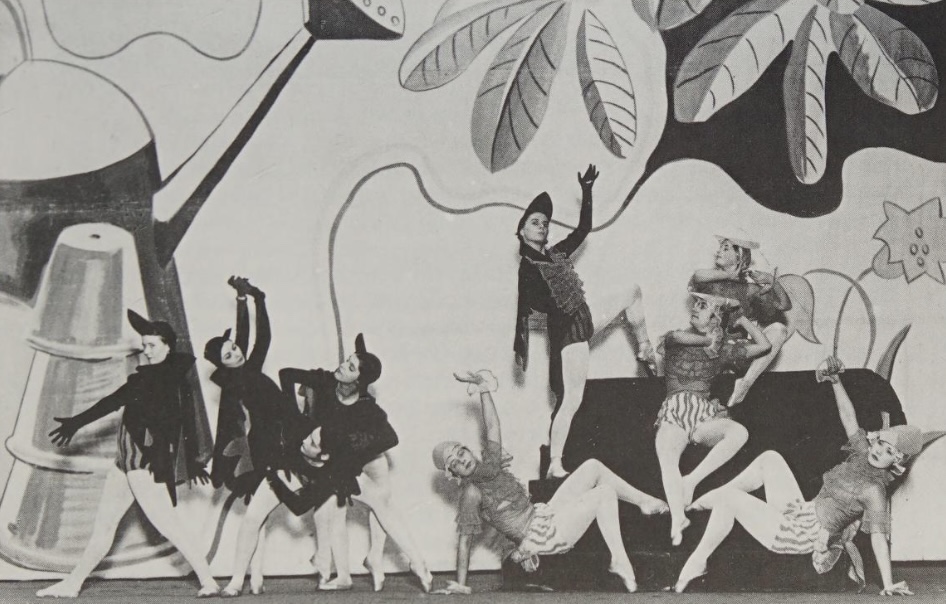
In the first few years of the company’s existence Beatrice appeared in a wide range of ballets. These included:
- The aforementioned The Jackdaw and the Pigeons
- Cephalus and Procris (de Valois) – danced the role of Aurora, a part originated by de Valois, debuted 1931
- Les Sylphides (Fokine)- Mazurka soloist, Vic-Wells production staged 1932
- The Lord of Burleigh (Ashton) – danced the role of Mariana in the 1932 Vic-Wells production
- High Yellow (Ashton, 1932) – originated the role of one of Violetta’s languishing friends
- The Scorpions of Ysitt (de Valois, 1932) – originated the role of the Goddess Ysitt in the revised version. In a review Beatrice was described by News Chronicle (16th November as ‘Greta Garbo’s double’. Gordon Anthony wrote that she danced with ‘stylised grace and regal dignity’.
- Douanes (de Valois, 1932) – originated a role as one of the Smiths
- The Birthday of Oberon (de Valois, 1933) – originated the role of Spring
- Pomona (Ashton) – danced the title role in the 1933 Vic-Wells production. The Western Morning News wrote that Beatrice made a ‘lovely and graceful goddess’ (19th January).
- Les Rendezvous (Ashton, 1933) – originated a role in the pas de six
- The Wise and Foolish Virgins (de Valois) – danced the Bride, a part originated by Alicia Markova, debuted 1933
- The Jar (de Valois, 1934) – originated the role of Nela, the Farmer’s Daughter. Rather frankly, The Era (17th October 1934) wrote that ‘her beauty contrasted wonderfully with the comparative ugliness of the other chief characters’.
- The Haunted Ballroom (de Valois, 1934) – originated the role of Beatrice
- Die Fledermaus (opera) – soloist in 1934
- The Nutcracker – Arabian soloist in the 1934 Vic-Wells production
- Giselle – Myrtha in the 1934 Vic-Wells production
- Rio Grande (Ashton) – danced the Queen of the Port in the 1935 Vic-Wells production
- Le Spectre de la Rose (Fokine) – danced the Young Girl in the 1932 Vic-Wells production, debuted 1935
- Le Baiser de la Fée (Ashton) – danced the Fairy, debuted c.early 1936
Aside from performing with the Vic-Wells Ballet she also participated in shows produced by the Carmago Society. This venture, coordinated by many influential figures in British ballet, staged several evenings of ballets a season between 1930 and 1933. She was also among the dancers who appeared in the 1935 film Escape Me Never, for which Frederick Ashton arranged the dances.

New Ventures
In 1936 Beatrice left the Vic-Wells Ballet to join the Markova-Dolin Ballet. This troupe was run by dancers Alicia Markova (1910-2004) and Anton Dolin (1904-1983). The pair had appeared with the Vic-Wells Ballet in leading roles, but were now focusing on their own company. The first mention of her in performances for the company comes from September 1936, when she danced in Southsea.
Some of her roles carried over from the Vic-Wells, as the Markova-Dolin ballet had taken the 2nd Act of The Nutcracker into their repertory. That said, there were plenty of ballets new to Beatrice too. Susan Salaman’s Show Folk, the famed Pas de Quatre and Bronislava Nijinska’s Les biches (staged under the name The House Party) were all ballets Beatrice danced in during her year with the company. The Markova-Dolin Ballet was primarily a touring company, visiting cities across England with short seasons in London.
Over the 1937-1938 Christmas season Beatrice danced as The Fairy in the Newcastle Empire Theatre’s pantomime Dick Whittington, starring alongside popular entertainer George Formby. She then began starring in a revue at the Windmill Theatre. This theatre was known for their Windmill Girls, who notoriously performed in the nude, but there were plenty of regular revue items on each bill. Beatrice, along with other Markova-Dolin dancers, took part in a ballet titled In a Viennese Garden, being singled out as a highlight. She continued at the Windmill into the Summer of 1938.

Around this time Beatrice also began taking part in television broadcasts, which were becoming more popular. In November 1938 she danced in a show entitled Fantastic Garden, which was broadcast on the BBC. However, this venture was one that could not continue, as television production in Britain was suspended during the Second World War.
1939-1945
1939 began for Beatrice with more television broadcasts, and then a short sojourn with the ballet company of the Adelphi Theatre. By August she was back at the Windmill, this time dancing in a Queen of Hearts ballet. 1939 ended for Beatrice with the pantomime Cinderella at the Alhambra Theatre in Glasgow.
Another run at the Windmill followed. The revues at the Windmill changed regularly, and their motto became ‘We Never Closed’. At the start of the war all theatres were shut down for just under a fortnight, but that would be the only time during the war that the Windmill would close. Beatrice was featured in a new ballet in each revue, and by 1940 she was the resident Ballet Mistress at the theatre. She also took up a job teaching mime at the Royal Academy of the Dramatic Arts.

In late 1940 the Blitz, a German bombing campaign on English cities, had commenced, but still the Windmill stayed open. Beatrice staged a circus ballet, Houpla!, which was performed, as one reviewer put it, ‘almost to the accompaniment of bombs’ (The Illustrated Sporting and Dramatic News, 4th October 1940).
1941 brought both new ballets and an engagement. The Tatler and Bystander (30th April 1941) reported on Beatrice’s engagement to John Pritchett. Pritchett was a pianist, and had worked as a Musical Director for theatrical productions. They married in 1941 in Maidenhead. I cannot find a conclusive date for their divorce, but Beatrice did remarry, so it must have happened.
That year’s pantomime of choice was Dick Whittington at the Alhambra Theatre London. Beatrice arranged the dances and starred as Fairy Sunbeam. The next year brought a tour with actress and dancer Tamara Desni. The show she performed in, entitled Grand Goings On, was described as a musical extravaganza, and Beatrice received good reviews.
Throughout the War Beatrice continued performing. Interestingly, there are no mentions of her in British newspapers at all in 1944, which seems to line up with mentions of her in Turkish-language sources. According to these sources she worked in Egypt, helping choreograph and perform works for the soldiers stationed there. This was not uncommon, but I’m afraid due to the language barrier I know no more about it.

The Post-War Years
By April 1945 she has returned to Britain, where she choreographed more balletic works. Her first major post-war job was dancing in a choreographing a revue at the Theatre Royal Brighton. The same revue, That’ll be the Day, then toured Britain.
The next couple of years went rather similarly. There were pantomimes, tours of the British provinces, and resident revues. During these years she formed a small group advertised as the Beatrice Appleyard Ballet. A 1947 feature in The Stage (22nd May) notes that the members of her group at this time were Jean Freeman, Claudine Goodfellow, Pamela Sheppard, Diana Dell, Tanya Duray and Janet Albuser.
Newspaper records show her own dancing career was slowing down at this point, as reviews of programmes she participated in note her as a choreographer, not as a dancer. This would not be a problem, as Beatrice’s choreography received good reviews in England, and, as we are about to see, abroad as well.
A Career Abroad
In January 1950 a short feature on Beatrice was published in The Tatler, which speaks of her work choreography a revue in Italy. This revue, Buondi, Zia Margherita, had recently opened in Rome, and according to the feature Beatrice’s work was received very positively.

She would be back in England in May to attend an Anniversary Gala for the ballet at Sadler’s Wells, attending by members of the company both past and present. An opportunity to choreography for Robert Helpmann arose, and Beatrice arranged a pas seul for his tour with Margot Fonteyn. She then became Helpmann’s assistant on the West End Musical Golden City, in which he choreographed the dances.
Another Italian revue, Cavalcata di Mezzo Secolo, followed in 1951, with Beatrice taking over a group of British dances to perform in the piece. A review in The Stage (13th December), noted that the level of dancing was higher than was customary in a revue.
It’s time now to catch up with Ninette de Valois. She had developed a successful new company, soon to become the Royal Ballet, and there was now a second company (today’s Birmingham Royal Ballet) attached. What she had achieved had been noted by others, and in the late 1940s she established a ballet school in Turkey which became attached to the Ankara State Conservatory. By 1954 the school had 34 girls and 16 boys as pupils, and the first class graduated in 1956. Once there were enough graduates, the Turkish State Ballet was formed.
de Valois knew that stability was the key to keeping the school open, and she sent over British dancers to help the school in its fledgling years. Among these dancers were Joy Newton, Molly Lake, Travis Kemp, Lorna Mossford, Robert Lunnon and Beatrice Appleyard.
Beatrice arrived in Turkey in 1951, becoming Director of the Ballet School. She left the school in 1954 when the Director of the Conservatory changed, but she remained in Turkey. This is because she had married the outgoing Director, pianist Mithat Fenmen. They would have a daughter together, who was born in 1956. She did return to teach at the School in 1963, continuing her association until the late 1970s.
Her own ballet school, the Fenmen Ballet Studio, was established following her departure from the Conservatory, and she ran this Studio until 1971. She retired from teaching in the early 1980s. Mithat Fenmen died in 1982, and in 1986 she published a book entitled Bale Tarihi.
Beatrice Fenmen died in Ankara on the 8th May 1994 at the age of 81. A well-attend ceremony at the Ankara State Conservatory was held in commemoration of her life. She is buried in Cebeci Asri Cemetary in Ankara.
Her legacy as a dancer, teacher, and choreographer lies both in Britain and Turkey. Those first few dancers who formed the Vic-Wells Ballet are often overshadowed by the ones who arrived just a few years later. I hope I have been able to show just how varied Beatrice’s career was, and I hope that this will make more people familiar with Beatrice.
Secondary Sources
Anthony, G. (1975). A camera at the ballet: pioneer dancers of the Royal Ballet. David & Charles.
Basar, D. (2018). From Petrushka to Çeşmebaşı: Tracing the Legacy of the Ballets Russes on the Turkish Ballet.
Benari, N. (1990). Vagabonds and strolling dancers: the lives and times of Molly Lake and Travis Kemp. Dance Books.
Bland, A. (1981). The Royal Ballet, the first fifty years. Doubleday.
de Valois, N. (1992). Come dance with me: a memoir 1898-1956. Lilliput.
Güçer, D. (2016). Çeşmebaşı Balesi’nin Türk Balesi’ne katkıları ve gelişimi.
Sorley Walker, K. (1985). The Festival and the Abbey: Ninette de Valois’ Early Choreography, 1925-1934, Part II. In Dance Chronicle, 8(1), pp. 51-100.
Sorley Walker, K. (1986). The Royal Ballet: a picture history. Threshold Books.
 Madeleine's Stage
wow!! 64Spotlight On: 18th Century Dancers in Britain
LikeLike