Previously in my series on forgotten ballets I looked at a 1926 ballet by George Balanchine, one of the most influential ballet choreographers. Today I’d like to look at a 1926 ballet by another influential ballet choreographer, who did the same for ballet in Britain as Balanchine did in America.
In 1926 Marie Rambert and her husband Ashley Dukes devised an idea for a ballet which would be choreographed by one of her students: Frederick Ashton. A Tragedy of Fashion; or, The Scarlet Scissors became Ashton’s first of many ballets, but did not enjoy the longevity of his later works.
Background
Ashton had taken class from Rambert before 1925, but following Léonide Massine’s departure from England in 1925, he went to Rambert again. At the time Rambert was teaching from a small studio that she shared with a sculptor, and Ashton wasn’t all that impressed at first. He attended class with other teachers, but Rambert let him train for free once he knew he couldn’t afford to pay.
1925 was the same year he debuted as a dancer, performing in small revue-type shows and in cinemas, back when it was common for movie theatres to feature live musicians and other acts. His first performance was in Brighton, at Brighton Pier, and he danced with Rambert’s small group of dancers as well. They often participated in variety performances, where there would be multiple different types of acts on the bill.
A Tragedy of Fashion was based on the letters of Madame de Sévigné (1626-1696), a French aristocrat whose letters were published by her family after her death. In one of these letters she details the story of François Vatel (1631-1671), an employee of Louis, Grand Condé (1621-1686). Vatel was in charge of preparing a banquet in honour of King Louis IV, and at the banquet a delivery of fish was late. The Madame writes that Vatel was so devastated by the delay he killed himself with a sword.
It was Rambert’s husband, Ashley Dukes, who proposed the story of Vatel would make a good idea for a ballet. Rambert agreed, but felt the banquet may prove to be too similar to Léonide Massine’s The Good-Humoured Ladies. This ballet featured a scene at the supper table, one of the most well-remembered scenes of the ballet. Rambert decided to change the profession of the tragic servant to costumier.
The name of the character based on Vatel became Monsieur Duchic, and Ashton was cast to dance the role. David Vaughan notes that Frances James was originally set to choreograph the ballet. James was a friend of Rambert who had experience choreographing, and she would dance a role in the ballet as well. According to Vaughan, when Ashton showed Rambert steps he had been considering for his character, she decided he should choreograph the piece.
I think the only thing for a choreographer is just to be in the right place at the right time and get down and do it…I’m sure that A Tragedy of Fashion was enormously derivative…But I dare say that in some ways it had something personal.
Frederick Ashton on his first ballet. In Dominic & Gilbert, 1973 (p.30)
Ashton himself notes that he was heavily inspired by the dancers he had grown up watching. Monsieur Duchic’s way of moving came from Léonide Massine, and the steps the girls danced were influenced by Bronislava Nijinska.
The ballet was set to music by British composer Eugene Goossens. His Kaleidoscope for piano Op. 18 had been composed in 1917, and was arranged by Ernest Irving for A Tragedy of Fashion. The costumes were designed by Sophie Fedorovitch. Ashton had been introduced to Fedorovitch through Rambert, and their partnership would continue until her death in 1953.
A Tragedy of Fashion premiered as part of a revue titled Riverside Nights. This revue was moving back to the Lyric Theatre Hammersmith following a run in the West End, and theatre manager Nigel Playfair had asked for a ballet to be included. The 4 Marie Rambert Dancers would perform the ballet for 6 weeks.
The Cast
Ashton danced Monsieur Duchic, and Marie Rambert danced Duchic’s partner Orchidée. Duchic was the only male dancing role in the ballet, just like Ashton was Rambert’s only regular male pupil.
Frances James danced one of the models, Rose d’Ispahan. James was the daughter of a Lieutenant-Colonel, Ralph H. James, and seems to have begun her dancing career in the early 1920s. She frequently danced in charity matinées; in December 1924 she appeared in a fairy ballet that she choreographed for a matinée in aid of ‘waifs and strays’. In 1929 she married a man named James Stannus, known professionally as Gordon Anthony. Anthony would become prominent as a photographer, focusing heavily on ballet photography. Frances’ sister-in-law was Edris Stannus, better known as Ninette de Valois. By 1932 they had a son named Paul, and she appears to have retired from dancing following her marriage.

The other model, Désir du Cygne, was danced by Elizabeth Vincent. While researching Vincent I was surprised to run into the biography of an America painter, Franz Kline (1910-1962). It turned out that Kline’s wife was a woman by the name of Elizabeth V. Parsons, who was a ballet dancer. She performed in the late 1920s under the name Elizabeth Vincent.
I decided to look through newspapers, as I thought Elizabeth Vincent may’ve been mentioned in other reviews of ballets. Rather annoyingly, and unfortunately, a lady of the same name was murdered in 1926, which made any results on our Elizabeth harder to find. Once I narrowed down the results it became more interesting. An Elizabeth V. Parsons, daughter of Colonel W. Forster Parsons, married a Mr William Loughton Lorimer in August 1929. There is no mention of whether this Elizabeth was a ballet dancer, but it’s possible that this is our Elizabeth, who is said to have retired from dancing in 1928.
If this is our Elizabeth, I have no idea what happened to William, but Elizabeth met Kline while she was working as a life model for a drawing class he attended at the Heatherley School of Fine Art in London. Kline spent the mid-1930s, and when he returned to America in 1938, Elizabeth went with him. Unfortunately, Elizabeth suffered from schizophrenia, and spent time in mental instructions. Kline died young in 1962, and I have been unable to find whether Elizabeth predeceased him or not.
The last two roles were taken by actors, not dancers. Esme (sometimes Esmé) Biddle and W. Earle Grey danced the Viscountess and Viscount Viscosa, Duchic’s customers. Both Biddle and Grey were actors in the Riverside Nights revue.
Miss Biddle was an actress who worked extensively in the UK and Ireland. She first came to prominence performing with the British Empire Shakespeare Society in the early 1910s, and grew as an actor throughout the decades. In 1927 she appeared in Stratford-upon-Avon with Shakespeare Memorial Theatre Ltd., the company which would become the Royal Shakespeare Company. Her most notable part there was the heroine of As You Like It, Rosalind. By the 1930s she was performing in Ireland, and continued to perform up until 1950. She was married to fellow actor Ian Priestly Mitchell, and died in 1951.
William Earle Grey also had an extensive resume as an actor, both in Britain and Ireland. During the 1910s he produced plays at Dublin’s Abbey Theatre, and was Secretary of the Irish Theatrical Artists’ Federation. He performed in the Shakespeare Memorial Theatre’s 1920 season, and was particularly well-reviewed in the role of Judge Brack in the Arts Theatre’s 1930 production of Hedda Gabler. Going into the 1930s he appeared on radio shows, and at the end of the decade moved to Canada with his wife Mary. While in Canada they founded the Earle Grey Players, performing Shakespeare plays across the country. They returned to England in 1960, and William died in 1978.
Reception
A Tragedy of Fashion premiered on the 15th June 1926, a landmark date for the Marie Rambert Dancers. The Rambert company today refer to A Tragedy for Fashion as their ‘founding work’, and a whole flurry of performances would come before the decade’s end.
Reviews of the ballet were mostly positive. The Daily News (17th June) leads its review with the headline ‘Gifted English Dancers’. This is true, but is most likely a nod to the fact that Playfair described the revue as ‘All-British entertainment’ (according to one review he disliked the word ‘revue’ because it came from the French language). Many reviews noted the involvement of Ashley Dukes, as his play The Man with a Load of Mischief had been successful in the West End.
It can however be said that the ballet wasn’t the focus of the evening. Reviews give equal notice to many of the acts, which included a send-up of Chekov, a revival of a 1769 short opera titled Thomas and Sally, and an appearance by future Bride of Frankenstein Elsa Lanchester. That information isn’t completely relevant, but I had to get it in there somewhere. Overall, the revue, or ‘entertainment’ as Mr Playfair might prefer, was noted for the range of acts it featured, and their originality.
Diaghilev was brought by Eugene Goossens to see the ballet twice, and liked it enough to offer Ashton an audition for the Ballet Russes. Ashton recalled that he got worked up about the audition, as he thought he could never match the standard of Diaghilev’s dancers. In the end he never actually made it into the theatre to see Diaghilev.
I thought I was made for life. I thought the offers would come pouring in. But nothing happened….Tragedy ran for six weeks at the Lyric and I suppose I was paid 10 pounds a week while it was on, but after that there was nothing.
Frederick Ashton. In Dominic & Gilbert, 1973 (p.30)
The run at the Lyric was the first and only time the ballet was performed in its entirety. Frederick Ashton kept the male solo in his repertory, performing it under the name The Swaggerer during appearances with the Mayfair Company of English Dancers.
In 1928 the Marie Rambert Dancers revived the solo for Rose d’Ispahan as the Mannequin Dance. This piece premiered on the 9th March 1928, and also included a pas de deux, though this was arranged by Rambert. A male solo, also arranged by Rambert, was added to the piece in October, and the divertissement was also performed as Mannequin and her Beau. Diana Gould first danced the solo with the Rambert company, and the Rambert performance database has the last recorded performance in 1931.
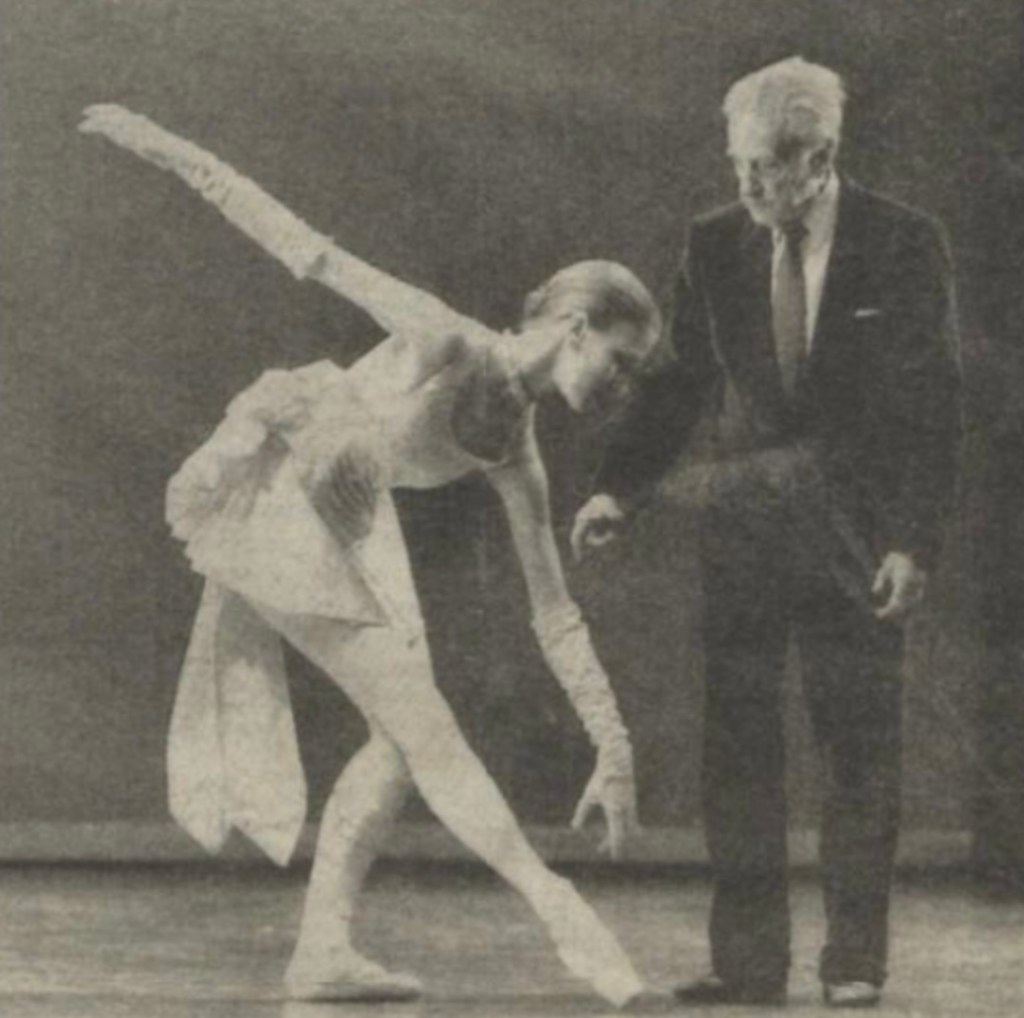
The Rose d’Ispahan solo was later revived at the Ballet Rambert’s Diamond Jubilee Gala, held on Wednesday 11th June 1986 at the Sadler’s Wells Theatre. Ashton and Gould reproduced the solo, which was danced by Sara Matthews. Critic Ann Nugent (The Stage, 19th June 1986) noted that the solo made clear the influence of Bronislava Nijinska on Ashton’s early work, and that the opportunity to see the piece was a highlight of the Gala.
Conclusion
Ashton’s first ballet is significantly more forgotten than his later successes, which is partially to be expected. It was only performed for six weeks, by a company that hadn’t fully established themselves yet, and it was the first work by Ashton. Those first works often aren’t remembered, but they provide an essential foundation for a budding choreographer.
Though A Tragedy of Fashion isn’t well known today, the Rambert company did not forget the ballet’s place in their history. In 2004, the centenary of Ashton’s birth, they premiered a reimagined contemporary version of the ballet. Choreographed by Ian Spink to music by Elena Kats-Chernin, the ballet featured a larger cast, but with the familiar Duchic at the centre of the piece. As we move closer towards the centenary of Ashton’s first work, it’s worth wondering whether Duchic or Rose may step back onto the stage once more.
Sources
Au, Susan. (1988). Ballet & modern dance. Thames and Hudson Ltd.
Beaumont, C.W. (1956). The complete book of ballets. Pitman.
Dominic, Z. & Gilbert, J. S. (1973). Frederick Ashton; a choreographer and his ballets. Henry Regnery Company.
Vaughan, David. (1999). Frederick Ashton and his ballets [Revised Edition]. Dance Books.
Frederick Ashton Foundation page on A Tragedy of Fashion: http://www.frederickashton.org.uk/scissors.html
Rambert page on A Tragedy of Fashion: https://rambert.org.uk/performance-database/works/a-tragedy-of-fashion-or-the-scarlet-scissors-from-the-revue-riverside-nights/?psort=venue&porder=asc

